Why Must Non-Standard Equipment Choose custom rubber parts?
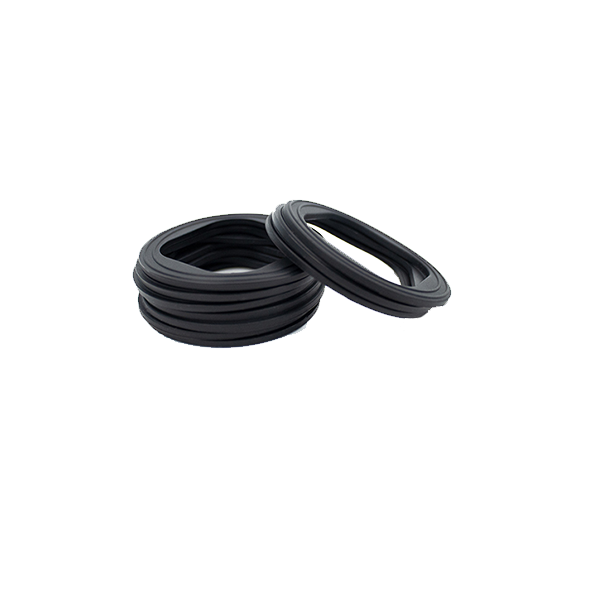
Non-standard equipment requires custom rubber parts because generic gaskets cannot fit irregular contours like rounded D-shapes. Custom silicone gaskets fit irregular structures precisely, filling micro gaps to resolve leakage and vibration risks completely.
Interface leaks almost caused my project to fail. If you are struggling with seal tightness in non-standard equipment, I invite you to read further. I will share my practical solutions.
How Do Shaped Silicone Gaskets Solve Interface Leaks?
Standard round gaskets twist easily when installed in irregular slots. Gaps allow moisture to penetrate inside equipment. I felt very anxious about this issue. So, I redesigned a shaped rounded D-ring silicone gasket.
Shaped rounded D-ring silicone gaskets use an irregular closed-loop shape. I used flat bottoms and curved tops to fit gaskets tightly against interface seats. This design produces even rebound force under pressure, achieving excellent face sealing performance.
| Gasket Structure |
Fitting Quality |
Compression Rebound |
Face Sealing Effect |
Target Interface |
| Standard Round Gasket |
Poor |
60% |
Prone to side leaks |
Standard Round Flat Slots |
| Symmetric Shaped Gasket |
Fair |
75% |
Partial compression distortion |
Symmetric Dual Slots |
| Custom Rounded D-Gasket |
Excellent |
92% |
Tight seamless seal |
Offset or Irregular D-Interfaces |
How to Choose the Right custom rubber parts Silicone Material for Industrial Environments?
Wrong rubber materials age and harden quickly under temperature fluctuations. Gaskets lose elasticity, reducing shock absorption capacity for equipment. This causes poor electrical contact. I had to find a better material.
Selecting proper custom rubber parts materials requires checking weather durability and compression set resistance. High-elasticity silicone stays flexible from -40°C to 200°C, making it an ideal choice for industrial waterproofing and equipment buffering parts.
Physical Performance of High-Elasticity Silicone Under Continuous Pressure
I conducted long-term pressure and weather tests on various sealing materials. Regular rubber gaskets showed significant elasticity decay after three months of compression lock. Interface seals loosened when equipment vibrated. I chose high-grade liquid silicone material. This material complies with the ASTM D395 compression set standard. It maintains a very low permanent deformation rate. Even after long-term tightening and repeated disassembly, gaskets recover original shapes quickly. I checked the Custom Rubber Parts design guide to adjust silicone hardness between Shore 50A and 60A. This hardness range guarantees installation flexibility while providing sufficient compression force.
Here is my comparison table of common industrial sealing materials:
| Material Name |
Plage de température |
Compression Resistance |
Weather Aging Resistance |
Recommended Application |
| NBR Rubber |
-20°C to 100°C |
Medium |
Fair |
Basic Industrial Oil Seals |
| EPDM Rubber |
-30°C to 130°C |
Good |
Good |
Automotive Door Weatherstrips |
| High-Elasticity Silicone |
-40°C to 200°C |
Excellent |
Excellent |
Custom Equipment Face Gaskets & Connectors |
Choosing proper structures and quality materials is the key to solving custom face sealing problems. I solved liquid leakage in complex interfaces by customizing shaped D-ring silicone gaskets. You can customize your own tooling based on specific needs.
How to specifically implement custom rubber parts?
Industrial data in 2026 shows that over 80% of EV charging equipment and automation makers use custom silicone seals in irregular sealing positions. These components comply fully with the SAE J1772 charging standard. I follow 4 clear steps:
- Measure Structures and Confirm Specs: I measure non-standard groove dimensions accurately first. I design rounded D-shaped contours in 3D software and set inner hole parameters.
- Build Molds and Test Pressure: I choose silicone with proper hardness for sample molding. I place sample parts in high-pressure testing units to verify sealing compression.
- Fine-Tune Molds and Produce: I optimize mold structures based on test results. I schedule automated silicone injection molding for mass production.
- Inspect Products and Verify Assembly: I install silicone gaskets into device interfaces. I inspect flatness and tightness to ensure zero micro-leakage gaps.
About Me and Dibo Tech
Brand Name: Dibo Tech
Slogan: Dibo Technology Silicone Manufacturing Specialists
Website: https://samxine.com/
Our Mission:
Grounded in strong technical capability and quality, we specialize in custom OEM and ODM silicone rubber production, offering reliable custom solutions for our clients while fulfilling social responsibility for a sustainable future.
About Me:
My name is Kunfa Ye, but my friends call me Jeff. I was born in 1986 under the sign of the Tiger. I started working in the silicone rubber manufacturing industry in 2014, and I now have fifteen years of experience. Over these years, I started from scratch and experienced every rise and fall in manufacturing. I know the hardships and rewards of entrepreneurship deeply. I always focus on professionalism and integrity in every project.
The silicone manufacturing industry seems ordinary, but it affects every part of industrial production. I know that trust stands behind every product, and trade relies on mutual success. Over the years, my proudest achievement is not achieving personal financial independence, but helping my clients optimize their supply chains and improve production efficiency. Their success brings me far more joy than personal achievements.
Now, I hope to give back to the industry—sharing experience, answering questions, and connecting resources. Whether you are a startup or an experienced industry peer, if I can help, I will do my absolute best. Because I always believe: the essence of business is the transfer of value, and true fulfillment comes from how much help you can bring to others.