ブログカテゴリー

詳細/分析

総記事数 61
How Do You Choose a Custom Silicone Products Manufacturer Without Burning Your Budget?
- ジェフ・イェ

How Do You Choose a Custom Silicone Products Manufacturer Without Burning Your Budget?

When you select a custom silicone products manufacturer, you’re not buying unlimited design freedom—you’re buying expertise in matching your product concept with material physics, mold constraints, and order economics. The manufacturer’s technical review process determines whether your project gets quoted accurately or hits expensive revision loops after you’ve already committed deposits

続きを読む
silicone products become sticky from oil bleeding on the molded surface
- Zhang

Why Silicone Products Become Sticky: 5 Causes & Fixes

When silicone products become sticky, the receiving team notices it before anyone opens a drawing: dust clings to the parts, poly bags weld to the surface, and in food-contact or medical programs the batch fails incoming inspection on sight. Silicone products become sticky for five controllable reasons — oil bleeding, an over-softened compound, incomplete curing, mold surface interaction, and storage conditions. All five can be specified, tested and verified before a purchase order is placed. This guide is built from how we diagnose tacky parts on our own LSR and compression molding lines: the tests we run on every batch, and the questions buyers should ask any supplier. Why Silicone […]

続きを読む
mixing defect containment sorting of custom rubber parts
- Zhang

Mixing Defect: 12,400 Rubber Parts Audited and Fixed

A mixing defect is the failure mode where parts of one part number end up inside the carton of another. It surfaced on one of our cable seal programs last month: an assembly line opened a box of 32A1PH seals and found 32A3PH parts mixed through the batch. The two parts differ by a few millimeters of body diameter — enough to fail a waterproofing test, not enough to catch by eye. Mixing defects cost far more than their size suggests. One wrong part in a sealed connector can fail an IP test, stop an assembly line, and trigger a recall investigation that costs more than the entire order. This […]

続きを読む
aluminum vs steel silicone mold cost comparison by production volume
- Zhang

Silicone Mold Cost: 10 Proven Ways to Reduce It

A silicone mold cost is quoted as a single number, but it is built from five blocks: steel, machining hours, polishing, sampling and engineering. Only two of them scale with part complexity — which is why the cheapest-looking quote is rarely the cheapest project. There are two ways to lower it. The slow way is negotiating the total price, which typically moves 5–8%. The fast way is changing the design before the first cut, which typically moves 20–35% and does not touch part quality. This guide covers both: what drives silicone mold cost, the ten decisions that reduce it, and the four places where cutting cost quietly creates a more […]

続きを読む
silicone mold surface finish comparison: matte, mirror and textured
- Zhang

Silicone Mold Surface Finish: 3 Types and How to Choose

A silicone mold surface finish is not a cosmetic decision. It is the texture of the steel, and every part produced from that tool will copy it for the life of the program. Specify it after the first samples fail and you pay twice — once to re-polish or re-etch the cavity, and again for the weeks lost. There are only three families of silicone mold surface finish: matte, mirror and textured. The choice is driven by four questions — how the part is seen, how it is gripped, how it releases from the cavity, and how it has to be cleaned. This guide covers all three, the SPI grades […]

続きを読む
liquid silicone rubber injection mold with cold runner manifold
- Zhang

Medical-Grade Liquid Silicone Rubber: Liquid Injection Molding Process & Machines

Liquid silicone rubber for medical devices is not a material choice — it is a closed process. The compound stays sealed from drum to cavity, the cure is triggered by heat rather than peroxide, and every parameter that affects biocompatibility is either documented or it is not. That closed loop is why medical programs run liquid injection molding (LIM) rather than compression. It is also why the questions that matter to a device buyer are different from the ones that matter to an industrial buyer: not "what hardness can you mold", but "which ISO 10993 endpoints did you test, on which lot, and what happens to the extractables profile after […]

続きを読む
companies that make silicone molds: compression molding press line
- Zhang

Companies That Make Silicone Molds: 7-Point Vetting Guide

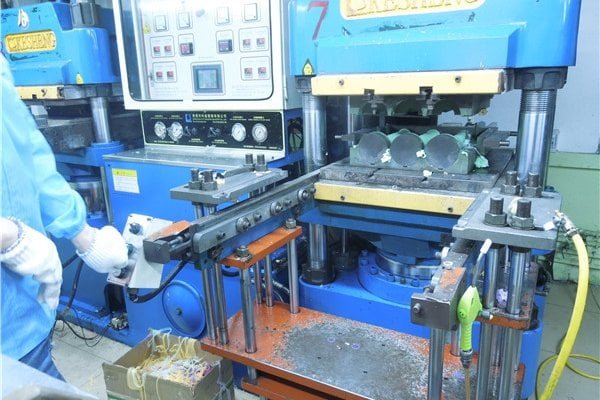
Companies that make silicone molds are not one category. Some cut steel tooling, some pour RTV rubber molds, some mold finished parts against your drawing — and the search term covers all three. Choosing the wrong type wastes a quotation cycle, and often a tooling deposit. For gaskets, seals, keypads, boots and thick-wall parts, the relevant route is almost always compression molding in solid HTV/HCR silicone. For thin walls and high cavity counts, it is liquid injection molding. This guide separates the supplier types, explains what a compression program actually involves, and gives you the questions that reveal whether you are talking to a factory or a broker. Five Kinds […]

続きを読む
80A Silicone Ice Cube Tray Mold for Freezing and Forming Ice Cubes
- Zhang

Silicone Hardness Guide: Shore A for Food Molds

Silicone hardness Shore A is the one number that decides whether a food mold releases cleanly or tears at the rim on the third demold. It is also the number most buyers copy from a competitor’s data sheet instead of deriving from their own part. This guide gives the ranges that actually work by application, and the reasoning behind each one. Silicone hardness Shore A for food-grade silicone molds almost always sits between 20A and 80A. Below 20A the cavity is too soft to hold its shape under batter or molten chocolate. Above 80A the mold stops flexing enough to release anything with an undercut. Inside that band, four things […]

続きを読む
Silicone Mold Shrinkage: What to Expect & How to Compensate
- Zhang

Silicone Mold Shrinkage: What to Expect & How to Compensate

Silicone mold shrinkage is the gap between the cavity you cut and the part you get, and it is the most common reason a first article fails a dimensional check. The percentage is small — typically 1.5% to 3% — but on a 150 mm enclosure that is up to 4.5 mm of missing part, which is the difference between a snap fit and a rattle. This guide covers what the number actually is, why LSR and HTV do not share it, how to measure your own compound instead of trusting a data sheet, and how to build the silicone mold shrinkage allowance into the tool before steel is cut. […]

続きを読む
LSR Injection Molding vs HTV: Food Grade Silicone Guide
- Zhang

LSR Injection Molding vs HTV: Food Grade Silicone Guide

HTV Compression vs LSR Injection Molding: How to Choose the Right Food-Grade Silicone Mold Process? Selecting the wrong silicone molding process causes high tooling costs and low production efficiency. You need a clear selection guide for your project. HTV compression molding suits low-volume, large-size, and simple products at lower tooling costs. LSR injection molding suits high-volume, high-precision, and flashless parts with short cycle times and extreme cleanliness. Many buyers focus solely on cheap tooling upfront, suffering low efficiency and high rejection rates during mass production. Follow my guide to understand the true differences between both processes. Why Are Low-Volume and Large-Sized Parts Better Suited for HTV food grade silicone molding […]

続きを読む
WhatsAppでチャットする