Custom Rubber Parts: Why Do Multi-Hole Array Thermal Silicone Pads Solve Heat Dissipation and Mounting Pain Points?
Overheating electronic components cause device crashes and hardware damage. Standard thermal pads lack mounting holes and cannot be bolted down. I solve your heat dissipation and mounting problems with this multi-hole array thermal silicone pad.
Professional custom rubber parts achieve thermal conductivity and structural compatibility through precision die-cutting and silicone formulation. By building a structured multi-hole array design with high-thermal-conductivity insulating silicone, we completely eliminated uneven heat dissipation and hole offset issues.
Many engineers struggle to find thermal pads that combine insulation, heat dissipation, and multi-hole bolt fixation. Read on as I break down our entire process from multi-hole array design to precision tooling.
Why Does a Multi-Hole Array Design Give Custom Made Rubber Parts Better Thermal and Mounting Compatibility?
Traditional thermal pads cannot be perforated directly for mounting.
Manual hole punching easily tears and deforms pad edges. Choosing custom tooling eliminates hole cracking risks from the source.
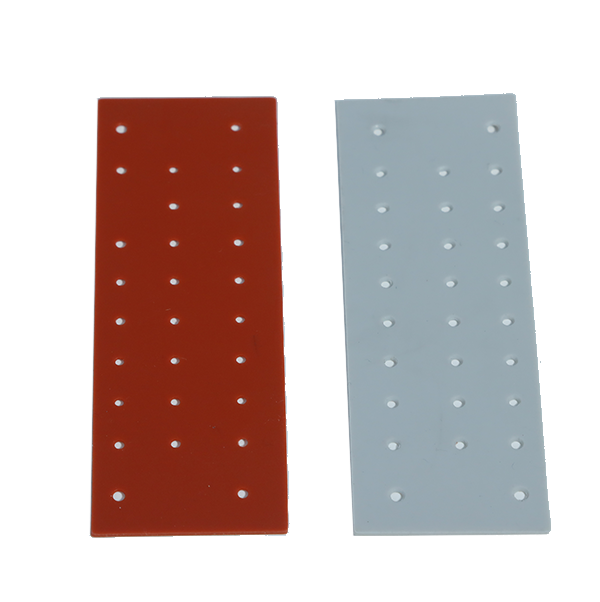
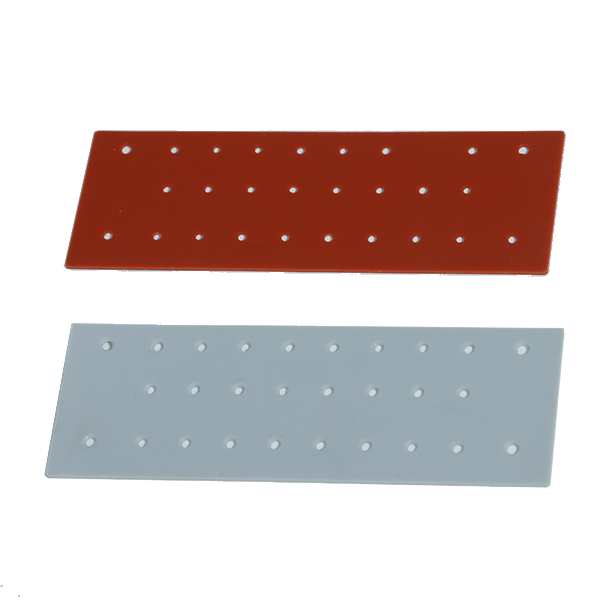
In electronic module assembly, custom made rubber parts can be custom-molded with multi-hole arrays according to circuit board layouts. The rectangular strip with regular through-holes guarantees large surface contact with heat sources while securely bolting components down.
Multi-Hole Array Tooling and Insulation Thermal Performance Analysis
In my fifteen years of silicone manufacturing experience, I have engineered many thermal accessories. This thermal silicone pad utilizes a regular multi-row through-hole design.
Ordinary thermal pads tear easily around hole edges after punching. We optimize mold die-cutting to ensure smooth, burr-free edges for every hole. High-elasticity silicone fills microscopic gaps between chips and heat sinks.
| Structural & Performance Metric |
Standard Non-Hole Pad (Forced Fit) |
Custom Multi-Hole Pad (Tailored) |
Impact on Heat Dissipation & Mounting |
| Hole Alignment |
Manual hole tearing & deformation |
Molded in one piece; tolerance ±0.05mm |
Zero edge tearing; fits PCB perfectly |
| Thermal & Insulation |
Limited gap filling; unstable insulation |
Fills microscopic gaps; high breakdown voltage |
Rapid heat transfer; protects circuits |
| Durability & Rebound |
Deforms under long-term compression |
High elasticity; resists thermal cycles |
Maintains stable heat transfer under vibration |
How Does Deep Customization Help Custom Rubber Parts Fit Non-Standard Electronics Cooling Needs?
Standard off-the-shelf sizes fail to fit non-standard structures.
Mismatched thermal conductivity causes poor heat dissipation efficiency. Precision tooling offers a cost-effective solution for your application.
A reliable factory customizes thermal pads according to client drawings. We support custom rectangular base sizes, hardness, colors, and thermal conductivity to ensure pads fit complex cooling modules seamlessly.
Precision Tooling and Parameter Controls
To resolve uneven gaps between heating elements and cooling modules, I led my team to control compound hardness. We adjust hardness from Shore OO 30 to Shore A 50 degrees.
We support custom Pantone colors such as red and grey. Products are widely used in new energy electronics, power modules, and LED lighting. Our manufacturing aligns with Custom Rubber Parts hardware specifications and general electrical standards.
| Custom Parameter Metric |
Engineering Standard & Specification |
Actual Confirmation & Delivery Results |
| Thermal Conductivity & Hardness |
Adjustable 1.5 - 6.0 W/m·K |
Balances softness and heat transfer; low-stress fit |
| Multi-Hole Die-Cutting |
High-precision steel die punching |
Precise hole spacing; supports automated assembly |
| Environmental Certification |
Complies with UL94 V-0 & RoHS standards |
Meets industrial high-temp & insulation standards |
In summary, multi-hole array design and high-thermal-conductivity insulating silicone form the bedrock of electronic device thermal safety. Through custom engineering, we help clients solve non-standard cooling and mounting incompatibility completely.
How to Specifically Operate custom rubber parts?
When manufacturing custom rubber parts thermal pads in volume, factories must follow standardized procedures. Third-party testing data shows that using precision die-cutting and compression molding with High-Temperature Vulcanized (HTV) silicone rubber keeps dimensional tolerances within ±0.05 mm while outgoing AQL reaches MA:0.4 / MI:0.65 standards.
- Drawing Audit & Array Tooling: Model based on client PCB hole drawings to design precise multi-hole array die-cutting tools.
- Silicone Compounding & Fillers: Mix in aluminum oxide or boron nitride fillers to adjust target Pantone colors and hardness.
- Vulcanization & Perforation: Mold base pads at optimal temperatures and punch through-hole arrays using precision steel dies.
- Testing & Delivery: Test thermal conductivity, breakdown voltage, and flatness before anti-static packaging and shipping.
External References & Industry Citations
- ISO 9001 Quality Certification: ISO 9001 Quality Management Systems Standard
- FDA Food Contact Regulations: U.S. FDA 21 CFR 177.2600 Food Contact Safety Regulations
- RoHS Environmental Directives: European Commission RoHS Directive 2011/65/EU
- PAX Technology Specs: PAX Technology Official Hardware Specifications
About Me and Dibo Tech
Brand Name: Dibo Tech
Slogan: Dibo Technology Silicone Manufacturing Specialists
Website: https://samxine.com/
Our Mission:
Grounded in strong technical capability and quality, we specialize in custom OEM and ODM silicone rubber production, offering reliable custom solutions for our clients while fulfilling social responsibility for a sustainable future.
About Me:
My name is Kunfa Ye, but my friends call me Jeff. I was born in 1986 under the sign of the Tiger. I started working in the silicone rubber manufacturing industry in 2014, and I now have fifteen years of experience. Over these years, I started from scratch and experienced every rise and fall in manufacturing. I know the hardships and rewards of entrepreneurship deeply. I always focus on professionalism and integrity in every project.
The silicone manufacturing industry seems ordinary, but it affects every part of industrial production. I know that trust stands behind every product, and trade relies on mutual success. Over the years, my proudest achievement is not achieving personal financial independence, but helping my clients optimize their supply chains and improve production efficiency. Their success brings me far more joy than personal achievements.
Now, I hope to give back to the industry—sharing experience, answering questions, and connecting resources. Whether you are a startup or an experienced industry peer, if I can help, I will do my absolute best. Because I always believe: the essence of business is the transfer of value, and true fulfillment comes from how much help you can bring to others.