HTV Silicone: What Is High Temperature Vulcanizing Silicone?
What Is HTV Silicone, and How Does It Function in Silicone Manufacturing?
Confused between HTV, LSR, and RTV silicones during sourcing? Selecting wrong materials inflates tooling budgets and triggers product rejections.
HTV Silicone is high temperature vulcanizing silicone rubber. Originating as a dense solid compound of base gum and fumed silica, it crosslinks under 160°C to 180°C pressure using peroxide catalysts, offering high tensile strength and broad heat stability.
Procurement managers and engineers frequently confuse solid and liquid silicone properties,I will break down the physical principles and processing benefits of HTV silicone.
What Is the Material Structure and Curing Principle of HTV Silicone?
Selecting incorrect vulcanization processes introduces air blisters and incomplete cures? Ignoring high-temperature vulcanization chemistry prevents proper quality control.
High temperature vulcanizing silicone crosslinks polymer chains at 160°C to 180°C via free radicals generated by peroxide decomposition. This solid-state reaction grants high tensile strength and low compression set.

Solid Compounding and Peroxide Crosslinking Mechanism
HTV Silicone begins as a dense solid rubber block or strip. It is compounded from base silicone gum, fumed silica reinforcement, structure control agents, and color pigments. It serves as a classic representative of high temperature vulcanizing silicone rubber. Material hardness spans Shore A 30 to 80.
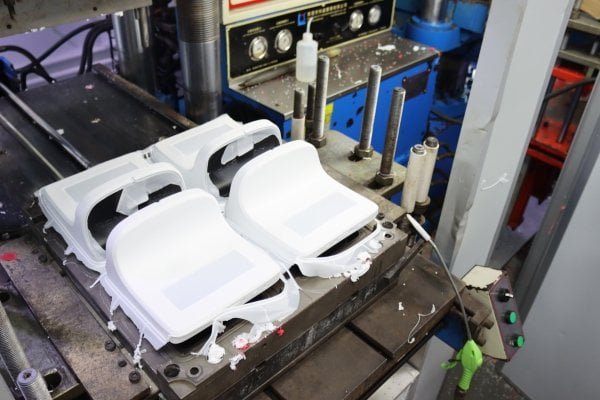
Inside flat compression presses, raw material undergoes 160°C to 180°C heat and pressure. Peroxide catalysts decompose into free radicals, crosslinking polymer chains into durable elastomers. Tensile strength reaches 7 to 10 MPa, with tear strength spanning 20 to 40 kN/m. The material withstands temperatures from minus 60°C to 230°C.
We strictly follow eCFR 21 CFR 177.2600 food contact standards. Food-contact components must undergo high-temperature post-curing baking to drive off volatile residues.
| Physical Property Metric | HTV Silicone Spec | Engineering Application Value |
|---|---|---|
| Hardness Range (Shore A) | 30° - 80° | Covers ultra-soft gaskets to rigid parts |
| Tensile Strength (MPa) | 7 - 10 MPa | Excellent tensile & deformation resistance |
| Temperature Resistance (°C) | -60°C to 230°C | Ideal for thermal cycling and heat exposure |
How Does HTV Silicone Compare to LSR and RTV Silicone?
Selecting wrong molding processes leads to expensive tooling or inefficient output? Misunderstanding material states increases post-processing and trimming expenses.
HTV is solid compression silicone with low tooling costs and flexible MOQs; LSR is liquid injection silicone offering high precision and zero flash; RTV cures at room temperature for potting and casting.
Material Forms and Process Selection Framework
In silicone manufacturing, distinguishing between these three material types is critical. HTV Silicone exists as a solid rubber block and uses hydraulic compression molding. Tooling uses cost-effective P20 steel or aluminum. Tooling costs remain low, with flexible MOQs starting around 500 pieces. Molded parts feature parting line flash that requires manual or cryogenic deflashing.
LSR is a two-component liquid silicone processed via automated injection molding. It utilizes hardened S136 mirror steel molds, yielding flashless parts with tight tolerances. RTV exists as a paste or fluid that cures at room temperature by absorbing ambient moisture, making it ideal for electronics potting and manual prototype casting.
| Parameter | HTV Silicone (Solid Compression) | LSR (Liquid Injection) | RTV (Room Temp Vulcanizing) |
|---|---|---|---|
| Initial State | Solid rubber block | 2-Part liquid silicone | 1 or 2-Part paste/fluid |
| Cure Condition | 160°C - 180°C heat | High-temp injection | Room temperature |
| Accuracy & Flash | Moderate accuracy, flash present | High accuracy, zero flash | Low accuracy, manual operation |
| Tooling Cost | Low (P20 steel/aluminum) | High (S136 mirror steel) | Very low (Unpressurized molds) |
What Are the Primary Applications of HTV Silicone in Molds and Parts?
Concerned about residual smells in HTV parts causing compliance failures? Neglecting post-curing and raw material controls risks product customs seizures.
HTV Silicone is widely used in oven gaskets, keypads, industrial seals, and large food molds. Post-curing ensures full compliance with FDA and LFGB food contact standards.

Industrial Applications and Food Compliance Controls
Applications for HTV Silicone span industrial and consumer sectors. It is commonly used for oven gaskets, silicone keypads, industrial seals, and large food molds like baking pans, ice trays, and chocolate molds. Because peroxide curing generates trace volatile byproducts, food-contact parts must undergo secondary vulcanization at 200°C for at least 4 hours.
Post-curing drives out residual odors and cyclic siloxanes. The material complies with ASTM D2000 material specifications. Our engineering team provides free DFM manufacturability evaluations based on your 3D CAD files. Operating dedicated high temperature vulcanizing silicone compression lines, our factory delivers reliable, compliant silicone solutions.
| Sector | Representative Product | Key Performance Need | Compliance Standard |
|---|---|---|---|
| Contacto con alimentos | Oven gaskets, baking mats, ice trays | Odorless, low volatiles, heat resistant | FDA 21 CFR 177.2600 / LFGB |
| Industrial Seals | High-pressure seals, engine gaskets | Oil resistant, low compression set | ASTM D2000 / ISO 3302-1 |
| Electronics | Remote keypads, protective boots | Elastic rebound, wear resistant | RoHS / REACH Directives |
In conclusion, HTV Silicone represents a cost-effective, heat-resistant solid silicone elastomer. With lower tooling investments and flexible MOQs, it remains the preferred option for large food molds and industrial gaskets. Proper post-curing ensures full compliance with food contact safety standards.
About the Author & Dibo Tech
My name is Kunfa Ye, but friends call me Jeff. I was born in 1986, the year of the Tiger. In 2011, my brother Autumn Ye and I co-founded Dibo Tech, rooting ourselves in the silicone rubber industry for fifteen years. Building from scratch, we navigated industry cycles and learned the true rewards of hard work. We have always built our business on technical expertise and integrity.
The silicone industry touches every corner of modern manufacturing. I deeply believe that behind every product lies trust, and the essence of business is mutual gain. Over these years, my proudest achievement is not personal financial independence, but helping our clients optimize supply chains and boost production efficiency. Their success is far more rewarding than personal milestones. Today, I aim to give back by sharing insights, answering engineering questions, and connecting resources.
Brand Name: Dibo Tech
Slogan: Dibo Technology Silicone Manufacturing Specialists
Website: https://samxine.com/
Our Mission: Based on strong technical capabilities and quality first, we are committed to innovative and eco-friendly silicone rubber production, providing reliable silicone solutions while fulfilling social responsibilities for a sustainable future.
Frequently Asked Questions (FAQ)
Q1: Is post-curing mandatory for all HTV Silicone products?
Answer: Post-curing is optional for standard industrial gaskets. However, food-contact products (such as baking mats and oven seals) must undergo post-curing at 200°C for at least 4 hours to drive off peroxide residues and odors to comply with eCFR 21 CFR 177.2600 standards.
Q2: What is the typical Minimum Order Quantity (MOQ) for HTV Silicone?
Answer: Because HTV solid compression molding features low setup and tooling costs, typical MOQs start around 500 pieces, making it suitable for short runs and new product testing.
Q3: How do I evaluate whether HTV Silicone is right for my product design?
Answer: If your product is large (such as a 30 cm baking mat), relatively simple in geometry, and not hyper-sensitive to parting line flash, HTV is the most cost-effective option. Send your 3D CAD files to our engineering team for a free DFM evaluation.
Deja un comentario