

Silicone Compression Molding Machine: Why Flash Runs Uneven
Why Does a Silicone Compression Molding Machine Make Uneven Flash?
Parts from the same cycle came back. Excess rubber squeezed out at the parting line is called flash. On this lot, the excess was paper thin on the left edge and thick enough to need a knife on the right. Inspection rejected the batch.
A silicone compression molding machine pushes excess rubber to one side when the base plate is not flat or the guide pins are worn. The two mold faces stop being parallel.

At first I blamed the silicone weight and the vents. The real problem was the plate under the mold, the one nobody looks at.
Why Does a Warped Base Plate Push Flash to One Side?
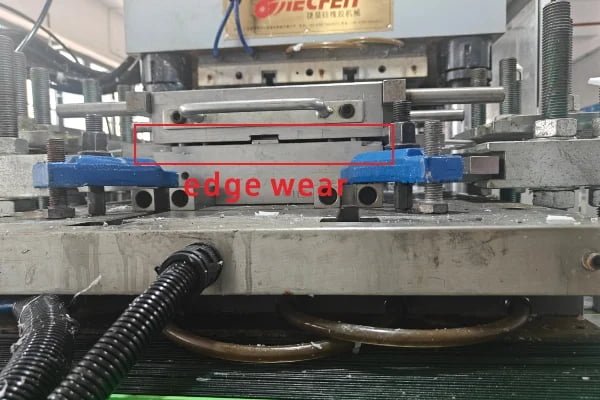
The mold does not rest directly on the table of the silicone compression molding machine. It rests on a base plate, and a tilted plate makes every mold on it tilted too.
A warped base plate closes tight on one edge and leaves a gap on the other. The silicone flows to the gap, so the excess builds there.
A few tenths of a millimeter doubles the flash
The base plate is also called a bolster plate, an insulation plate, or the lower heating platen. The mold rests on top of it. When the plate is flat and the mold is seated square, the two mold faces close perfectly parallel.
Once the plate sags in the middle, or drops on one side, the mold tilts with it. The press closes tight on one edge and leaves a gap on the other. The gap changes steadily along the parting line, from about 0.05 mm at one end to 0.15 mm at the other.
Under pressure, the silicone flows toward the path of least resistance. The wide gap is that path, so silicone squeezes into it. Doubling the excess thickness is common.
A warped plate causes a second problem: uneven temperature. Where the plate and the mold do not touch well, heat transfer drops, and that area runs cooler. A cooler area cures slower, and the part may stay under-cured there. Hardness drops and rebound suffers.
So uneven flash and a soft spot often share one cause. A hardness test to ASTM D2240 can confirm it. Take parts from different positions in the same cycle. If the hardness spread is wider than normal, the temperature distribution is off.
| Base plate condition | How the mold closes | Flash pattern |
|---|---|---|
| Flat | Faces parallel | Even all around |
| Sagging in the middle | Gap at the center, tight at the edges | Thick at the center, thin at the edges |
| Dropped on one side | Tight on one side, gap on the other | Thick on one side, linear taper |
| Mounted out of level | Whole mold tilted | One side comes out thick, direction fixed |
A bubble level only gives a rough idea. For an accurate reading, run a dial indicator across the plate surface at several points and compare the readings. Parallelism of the mold faces should be settled at the design stage. We put those checks into a DFM checklist for silicone molds.
Why Does the Thick Side Change From Cycle to Cycle?
This cycle came out thick on the left. The next one may come out thick on the right. That randomness points to the mold location, not to the material.
Worn guide pins let the two mold halves shift sideways. The shift goes in a random direction, so the thick side moves with it.
Sideways shift and angular tilt are two different faults
A warped base plate causes angular tilt. The two mold faces sit at a small angle. The excess thickness changes along one direction, and the thick side stays in the same place every cycle.
Worn guide pins cause a sideways shift. The two halves offset in the horizontal plane. One edge of the parting line opens into a step, silicone fills it, and a thin sheet forms.
The two faults look different. With angular tilt, the thick side stays put. With a sideways shift, the position moves, because the mold settles into a random spot each time it closes.
When the bushing clearance opens up, the mold rocks slightly during closing. Whichever side it rocks toward gets the thick flash. So within one lot, the thick edge can sit on the left for a while and then move to the right.
That difference is the fastest way to sort them. A fixed thick side points to the base plate. A moving thick side points to the guide pins.
| Fault type | Cause | Flash pattern | How to check |
|---|---|---|---|
| Angular tilt | Warped plate, worn spacers | Fixed position, linear taper | Dial indicator on the plate |
| Sideways shift | Worn guide pins and bushings | Random position, changes per cycle | Feeler gauge around the parting line |
| Both together | No scheduled inspection | Larger spread, plus soft spots | Check both |
Our case was both. The plate had a slight warp, and the guide pins were worn. Neither was severe alone. Together, the flash difference was visible to the naked eye. A cheaper mold usually wears faster. Money saved on steel and machining comes back as shorter tool life, and we covered that trade-off in our guide to lowering silicone mold cost.
How Do You Tell Machine From Mold in an Hour?
Swap the mold, swap the press, add shims. Many people test for a day and still have no answer.
Three steps: check the base plate, measure the parting line gap, swap the press. After that, you know whether it is the machine or the mold.
Rule out the part that never moves first
Step one, pull the mold and run a dial indicator across the base plate. Take readings at the four corners and the center. If the spread is out of range, the plate itself is not flat. Any mold placed on it will produce uneven flash.
Step two, once the plate checks out, put the mold back and measure the gap around the parting line with a feeler gauge while the press is closed. If the front edge reads 0.05 mm and the back edge reads 0.15 mm, the mold is sitting crooked, or the guide pins have lost their alignment.
Step three, run the same mold on another press. If the flash comes out even there, the problem sits in the original plate or machine. If it stays uneven, the problem is in the mold.
| Step | Tool | What the reading means |
|---|---|---|
| Check the plate | Dial indicator | Spread out of range means a machine problem |
| Measure the gap | Feeler gauge | Uneven around the edge means a crooked mold or worn pins |
| Swap the press | Same mold, second machine | Even on the second press means machine, still uneven means mold |
The order matters. Check the part that never moves before the part that does. The base plate is the reference. If the reference is wrong, every reading after it is wrong too.
The excess is also a dimensional matter. ISO 3302-1 sets tolerance classes for molded rubber parts, and a thick edge on one side can push a part out of its class even when the cavity itself is correct.
Final Thoughts
Our problem was a warped base plate and worn guide pins together. We ground the plate flat, replaced the pins, and the flash came out even. Inspection data went back to normal.
Looking back, this was a textbook silicone mold misalignment flash defect. Two faults produced one visible symptom, and both were easy to miss. The base plate never moves and never gets replaced, so nobody thinks to check it. Guide pin wear is slow. A little each day, and you cannot feel it. By the time flash runs thick on one side, the pins have been wearing for months.
So we put both items on a schedule. The maintenance team now checks base plate flatness and mold location accuracy every three months. We do not wait for a defect to start looking. That is preventive maintenance as ISO 9001 describes it: a defined check, a defined interval, and a record.
A machine tells you when it breaks. It says nothing while it wears.
If your flash comes out thick on one side, send us the machine model, the mold temperature and a photo. Talk to us.
Frequently Asked Questions
Can I fix uneven flash by raising the clamp pressure?
No. Pressure changes the total flash thickness, not how it is distributed. An uneven gap comes from faces that are not parallel. Add pressure, and both sides get thicker while the difference stays.
If the base plate is warped, can I just add shims?
For one short production run, yes. Long term, no. A shim fills one spot, not a warped face. It also changes heat transfer, and that area may run cooler. The proper fix is to grind the plate flat or replace it.
How often should guide pins be replaced?
There is no fixed interval. It depends on cycle count and maintenance. We check location accuracy every three months and replace when it moves out of range. Waiting until flash goes bad means losing a batch first.
About the Author & Dibo Tech
My name is Kunfa Ye, but friends call me Jeff. I was born in 1986, the year of the Tiger. In 2011, my brother Autumn Ye and I co-founded Dibo Tech, rooting ourselves in the silicone rubber industry for fifteen years. Building from scratch, we navigated industry cycles and learned the true rewards of hard work. We have always built our business on technical expertise and integrity.
The silicone industry touches every corner of modern manufacturing. I deeply believe that behind every product lies trust, and the essence of business is mutual gain. Over these years, my proudest achievement is not personal financial independence, but helping our clients optimize supply chains and boost production efficiency. Their success is far more rewarding than personal milestones. Today, I aim to give back by sharing insights, answering engineering questions, and connecting resources.
Brand Name: Dibo Tech Slogan: Dibo Technology Silicone Manufacturing Specialists Website: https://samxine.com/ Our Mission: Based on strong technical capabilities and quality first, we are committed to innovative and eco-friendly silicone rubber production, providing reliable silicone solutions while fulfilling social responsibilities for a sustainable future.
コメントを残す