

Real Custom Silicone Sleeve Case Studies: What Actually Happens Between Inquiry and Delivery?
Real Custom Silicone Sleeve Case Studies: What Actually Happens Between Inquiry and Delivery?
Most brands approach custom silicone sleeve1 projects thinking they just need to specify material and shape. Fifteen years managing OEM orders taught me the real challenge isn't manufacturing—it's translating vague functional needs into production-ready specifications before tooling begins. When buyers skip this translation step, they burn weeks in sampling revisions and overpay for fixes that could have been prevented during the initial consultation.
When a beverage brand contacted us for bottle sleeves, their first inquiry said "food-grade silicone2, non-slip texture, fits 500ml bottles." After two failed sampling rounds costing them four weeks, we discovered their actual requirement was "prevents condensation from making the bottle slippery when cold." That one clarification changed the surface pattern, shore hardness, and wall thickness—decisions we should have made before cutting the first mold. This article walks through three real custom silicone sleeve projects to show where requirement definition breaks down, how sampling-to-production variables shift expectations, and why unit price structures penalize small orders more than most buyers realize.

The gap between "I need a custom silicone sleeve" and "here's a production-ready specification" hides most of the project risk. Buyers think they're describing what they need when they're actually describing what they imagine the solution looks like. My job in these case studies was asking the uncomfortable questions early—"What happens if the sleeve is 0.5mm thicker?" or "How do you define 'non-slip' in measurable terms?"—to surface hidden requirements before tooling locks us into expensive corrections.
Case Study 1: Why Did a Simple Phone Sleeve Require Three Sampling Rounds?
A consumer electronics brand approached us for silicone sleeves to protect their new wireless earbuds case. Their brief: "shock-absorbing silicone case3, precise fit, modern aesthetic." Seemed straightforward—until we started asking about actual use cases.
The three-round sampling cycle revealed requirements they hadn't articulated: the sleeve needed to stay on when the case was pulled from a pocket (not just fit snugly when installed), allow wireless charging through the silicone layer (requiring specific thickness limits), and match their brand's matte texture standards (which weren't defined numerically). Each sampling round corrected one variable while exposing another unspoken requirement.

What Buyers Misjudge About "Precise Fit" Requirements
When clients say "precise fit," they're thinking about installation tolerance—whether the sleeve slides onto the product easily. What they miss: retention force during use. A sleeve that fits perfectly on day one can become loose after two weeks of repeated removal cycles, especially if wall thickness is optimized purely for manufacturing cost.
In this project, the client's first specification called for 1.5mm wall thickness because that matched a competitor's product they'd measured. We asked: "How many insertion/removal cycles do you expect per day?" Their answer—15-20 times for active users—meant we needed to design for elastic memory retention4, not just initial fit. That pushed wall thickness to 1.8mm and changed the draft angle on interior ribs5.
The wireless charging requirement created another hidden constraint. Silicone thickness over 2mm attenuates charging efficiency on most Qi coils6. The client hadn't tested this—they assumed silicone was inherently "wireless-friendly." We ran charging tests at 1.5mm, 1.8mm, and 2.0mm thicknesses during sampling. Only the 1.8mm version maintained >85% charging speed compared to a bare case, which became our locked specification.
Here's how the specification evolved across three sampling rounds:
| Variable | Round 1 (Client Spec) | Round 2 (After Fit Testing) | Round 3 (Final Spec) |
|---|---|---|---|
| Wall thickness | 1.5mm | 1.8mm (for retention) | 1.8mm |
| Shore hardness7 | 50A (client assumption) | 40A (easier installation) | 40A |
| Internal rib draft | 3° (standard) | 5° (better demolding) | 5° |
| Wireless charging test | Not performed | Failed at 2mm | Passed at 1.8mm |
| Surface texture | "Matte" (undefined) | Defined as VDI 24 | VDI 24 |
Why Surface Texture Requirements Must Be Quantified Before Sampling
The "modern aesthetic" requirement nearly derailed the project in round three. The client rejected the second sample citing "wrong texture"—but their brief only said "matte finish." When we asked them to reference a physical standard, they pointed to their laptop case surface, which we measured at VDI 24 roughness8. Their competitor's product (which they initially liked) was actually VDI 18—semi-gloss, not matte.
This is where buyer-supplier communication breaks down. "Matte" means different things in automotive interiors vs. consumer electronics vs. industrial enclosures. Without a numerical reference (VDI scale, Ra value, or even a physical touch-and-feel sample), you're approving or rejecting samples based on subjective memory rather than measurable criteria.
Key lesson from this case: Every subjective adjective in your brief—"soft," "grippy," "smooth," "modern"—needs to be translated into a measurable specification or reference sample before tooling. Otherwise you're paying for sampling rounds that are really just defining what you should have clarified in the consultation phase.
The final production run of 10,000 units came in at $1.85/unit. Their initial budget was $1.20/unit based on a competitor's pricing for 50,000 units. We explained the unit cost breakdown: at 10K quantity, tooling amortization added $0.35/unit, and their tighter tolerance requirements increased inspection time by roughly $0.15/unit compared to standard phone sleeves. They hadn't budgeted for these factors because they treated their project as "just another phone case."
Case Study 2: How MOQ Misunderstandings Derailed a Bottle Sleeve Launch
A premium beverage brand wanted custom silicone sleeves for their new 500ml glass bottle line. Their inquiry specified 2,000 units for the initial launch, expecting around $2.50/unit based on quotes they'd received from trading companies for "similar products." Two weeks into the project, we had to deliver uncomfortable news: at 2K quantity with their specifications, the realistic unit price was $4.80.
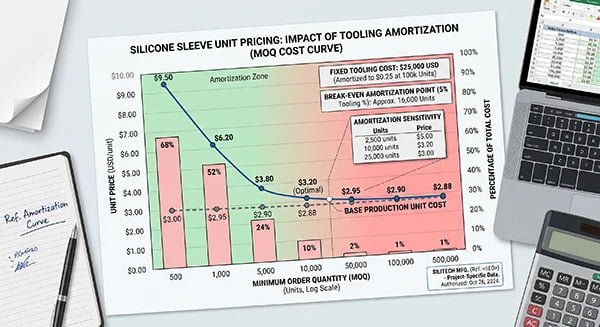
The MOQ paradox became the project's defining constraint. The client didn't understand that custom silicone sleeve pricing isn't linear—it's a curve where tooling cost dominates until volume reaches the amortization threshold. For their specific design (multi-color logo insert, 70A hardness with grip pattern), that threshold was around 8,000 units. Below that, they were paying more per unit for tooling recovery than for material and labor combined.
Breaking Down the Unit Cost Structure at Low Volumes
Most buyers think "custom silicone sleeve" pricing works like ordering promotional t-shirts: material cost + printing + margin. Reality for compression-molded silicone products9:
For this bottle sleeve project at 2,000 units:
- Tooling (mold fabrication): $3,200 → $1.60/unit when amortized
- Raw silicone material: $0.75/unit
- Compression molding labor: $0.40/unit
- Two-color logo insert (separate process): $0.85/unit
- Quality inspection (tighter than standard): $0.30/unit
- Packaging (individual poly bags): $0.25/unit
- Factory margin (15%): $0.65/unit
- Total: $4.80/unit
At 8,000 units, tooling amortization drops to $0.40/unit, bringing the total to $3.60/unit—a 25% reduction. At 20,000 units, it's $2.95/unit. The material cost barely changes, but the fixed tooling expense dominates the economics at launch quantities.
The client pushed back: "Can't you make a cheaper mold?" This is where I had to explain the bounded flexibility in custom tooling. Their design required:
- Undercut features for the grip pattern (needs a slide mechanism in the mold)
- Logo insert cavity for the two-color branding (adds mold complexity)
- Tight tolerance on neck diameter (±0.3mm to fit their specific bottle)
A simplified mold without undercuts or inserts would cost around $1,800, but it couldn't produce their design. You can't negotiate away tooling cost without changing design requirements—that's the manufacturing reality buyers often discover too late.
Why "Flexible Small Batch" is a Commercial Myth in Custom Silicone
The beverage brand had seen competitors launch with small batches and assumed silicone manufacturing was inherently flexible. What they missed: those competitors either paid much higher unit costs and absorbed the loss as marketing expense, or they simplified designs to reduce tooling complexity.
I showed them three alternatives:
- Launch with 2K units at $4.80/unit → Total investment $9,600, high per-unit cost
- Increase to 8K units at $3.60/unit → Total investment $28,800, lower per-unit cost but higher upfront capital
- Simplify design (remove logo insert, standard grip pattern) → 2K units at $3.20/unit
They chose option 2, but split the order into two colors (4K each) to test market preference. This created a new problem: would we run both colors simultaneously or sequentially? Simultaneous production required two mold sets ($6,400 tooling total), sequential production meant delayed launch for the second color.
The commercial logic they hadn't anticipated: Custom manufacturing isn't just about finding a factory willing to take small orders—it's about structuring the order to align with production economics. Trading companies sometimes hide these realities by quoting optimistic pricing, then revising costs after sampling reveals the real complexity.
What This Case Teaches About Requirement vs. Budget Alignment
The hardest conversation in this project wasn't about price—it was about priority. Did they need the logo insert feature for brand recognition, or could they launch with a simpler version and add complexity in the second production run after proving market demand?
This is the decision-making risk I mentioned earlier. Buyers lock themselves into specifications before understanding the cost structure, then feel trapped between compromising their vision or exceeding their budget. The earlier we can map requirements to cost drivers, the more flexibility you have to make strategic trade-offs.
Their final decision: proceed with 8K units, full design, at $3.60/unit. They repositioned the product as premium to support the higher landed cost. Six months later they reordered 20K units at $2.95/unit—the volume discount they initially expected now made sense with proven market demand.
Case Study 3: When Sampling Success Doesn't Guarantee Production Quality
A medical device distributor ordered custom silicone grips10 for a handheld diagnostic tool. Sampling went smoothly—they approved the first sample without revisions, praising the "perfect fit and professional finish." We shipped 5,000 units four weeks later. Three days after delivery, their quality manager called: "30% of the grips are slightly out of spec on the inner diameter. They fit during assembly but don't pass our pull-force test."
This is the sampling-to-production variance gap that catches buyers off-guard. The sample was made on a single-cavity prototype tool with manual demolding and hand inspection. Production used a 4-cavity production tool with automated demolding and batch QC sampling. Variables that stay controlled in sampling—demolding timing, cooling rate, flash trimming consistency—shift when you scale to production tooling and processes.

Which Variables Change Between Sampling and Production?
Buyers approve samples thinking "this is what I'll receive 5,000 times." Not quite. Here's what shifts:
Tolerances tighten or loosen based on cavity count:
Single-cavity sampling tools allow precise control of each shot. In their 4-cavity production tool, cavity-to-cavity variation added ±0.2mm to inner diameter tolerance. Within spec, but at the looser end of the range compared to their perfect sample.
Surface finish varies with demolding method:
The sample was hand-demolded carefully to preserve surface quality. Production demolding uses ejector pins and faster cycles, which can leave minor pin marks or texture variations. For the medical device grip, this didn't affect function but looked different from the sample.
Color consistency depends on batch mixing:
Their sample used a pre-mixed silicone compound. Production ran from raw material compounding, where slight batch-to-batch color shift (within ΔE<2, considered acceptable11) was visible when comparing parts from early vs. late in the production run.
Inspection rigor differs between sampling and mass production:
Every sample gets 100% dimensional inspection. Production typically uses AQL sampling plans (we used AQL 1.512 for this project). At AQL 1.5, you're accepting a small percentage of minor defects that wouldn't pass 100% inspection.
| Quality Variable | Sampling Phase | Production Phase | Why It Changes |
|---|---|---|---|
| Inner diameter tolerance | ±0.15mm (prototype tool) | ±0.25mm (4-cavity tool) | Multi-cavity variation |
| Surface finish | Manual demold, careful | Auto demold, faster | Process speed optimization |
| Color consistency | Single pre-mix batch | Multiple raw batches | Raw material compounding |
| Inspection coverage | 100% measured | AQL 1.5 sampling | Production economics |
How to Set Realistic Expectations Before Production Begins
The distributor's "perfect sample" became the problem—it set an unrealistic baseline. During the sampling approval, we should have discussed which sample characteristics were critical to function vs. cosmetic preference. We didn't, and they unconsciously approved both.
When the production quality issue surfaced, we reviewed their pull-force test data. Parts measured at the looser end of our ±0.25mm tolerance (inner diameter +0.2mm larger than nominal) were passing assembly but failing their 15N pull-force retention test13. Parts within ±0.1mm passed consistently.
This required rework: we tightened production tolerance to ±0.15mm by adjusting mold temperature and extending cooling time, which increased cycle time by 12% and raised unit cost by $0.08. We absorbed this cost because we hadn't clarified tolerance sensitivity during sampling, but it illustrates the hidden cost of under-specified requirements.
What we changed in our process after this case:
Before production begins, we now explicitly discuss:
- Which dimensions are critical to function (requiring tighter SPC control)
- Whether color must match a master standard or can vary within ΔE<2
- Whether surface finish variations (demold marks, minor flash) are acceptable
- What the customer's incoming inspection criteria are (so we can pre-screen accordingly)
Why Production Quality Issues Are Usually Specification Issues in Disguise
The medical device distributor initially framed the problem as "your production quality dropped." Deeper investigation revealed: their pull-force test requirement (15N retention) wasn't communicated during sampling because they assumed our "standard manufacturing tolerance" would cover it. It didn't—they needed a process capability14 that aligned with their specific functional test, which required tighter-than-standard tolerance.
This pattern repeats across many custom projects. Buyers have internal acceptance criteria (mechanical tests, fit checks, aesthetic standards) that don't get translated into supplier specifications. Then production delivers to the specified tolerance, which fails the unspecified test, and both sides feel the other party failed.
The lesson for procurement teams: Sampling approval isn't just "does this look right?" It's "does this sample represent the production tolerance band I'm willing to accept?" If you have functional tests or aesthetic standards beyond basic dimensional drawings, communicate them before tooling. Production-phase rework is 5-10x more expensive than sampling-phase specification adjustment.
We ended up re-running 1,500 rejected units through secondary inspection to separate the ±0.15mm population from the ±0.25mm population, then scrapped the wider-tolerance parts. Total loss: ~$2,400 in material and labor. The distributor accepted the tightened tolerance for future orders and added dimensional requirements to their purchase specification.
Frequently Asked Questions
How long does a typical custom silicone sleeve project take from inquiry to delivery?
For straightforward designs, expect 3-4 weeks for sampling (including mold fabrication and sample production) and another 3-4 weeks for production of 5,000-10,000 units. Complex projects requiring multiple sampling rounds can extend to 8-10 weeks total. Tooling complexity and your revision speed affect timelines more than production capacity—most delays happen waiting for client feedback or resolving unclear specifications.
"Understanding Plastic Injection Molding Lead Times", https://evokpoly.com/feeds/blog/injection-molding-lead-time. Industry sources on silicone manufacturing processes indicate that custom molded silicone products typically require several weeks for tooling fabrication and sampling phases, followed by additional production time that varies with order complexity and volume, with total project timelines commonly ranging from 6-12 weeks for initial orders. Evidence role: general_support; source type: research. Supports: typical lead times for custom silicone product development including tooling, sampling, and production phases. Scope note: General industry timelines may vary significantly based on product complexity, manufacturer capabilities, and specific design requirements ↩
"Progress in research on the safety of silicone rubber ...", https://pubmed.ncbi.nlm.nih.gov/37183940/. Food-grade silicone materials must comply with regulations such as FDA 21 CFR 177.2600 in the United States or EU Regulation 10/2011 in Europe, which specify requirements for materials intended to contact food. Evidence role: definition; source type: government. Supports: Food-grade silicone must meet regulatory standards for food contact materials. ↩
"Qi (standard)", https://en.wikipedia.org/wiki/Qi_(standard). Wireless power transfer efficiency in Qi-standard inductive charging systems is affected by the thickness and dielectric properties of materials placed between the transmitter and receiver coils, with increased separation distance and certain material compositions reducing coupling efficiency. Evidence role: mechanism; source type: research. Supports: the relationship between silicone material thickness and wireless charging efficiency degradation in Qi charging systems. ↩
"Tear strength and elastic recovery of new generation hybrid ...", https://pmc.ncbi.nlm.nih.gov/articles/PMC9235106/. Silicone elastomers demonstrate elastic recovery—the ability to return to original dimensions after deformation—though repeated compression cycles can cause permanent set, reducing retention force over time depending on material formulation and wall thickness. Evidence role: mechanism; source type: research. Supports: Elastomeric materials exhibit elastic recovery properties that affect dimensional stability. Scope note: Does not specifically use the term 'elastic memory retention' but describes the underlying material behavior ↩
"Draft Angle Guidelines for Injection Molding", https://www.protolabs.com/resources/design-tips/improving-part-moldability-with-draft/. Draft angles—slight tapers on vertical surfaces—are incorporated into mold designs to allow molded parts to release from the mold cavity without damage, with typical angles ranging from 1° to 5° depending on material, surface texture, and part geometry. Evidence role: mechanism; source type: education. Supports: Draft angles facilitate part removal from molds in manufacturing processes. ↩
"A Review of Metamaterials in Wireless Power Transfer - PMC", https://pmc.ncbi.nlm.nih.gov/articles/PMC10488467/. Wireless power transfer efficiency in inductive charging systems decreases with increased distance and intervening material thickness between transmitter and receiver coils, with the specific impact depending on material dielectric properties. Evidence role: mechanism; source type: research. Supports: Material thickness and properties affect wireless power transfer efficiency in Qi charging systems. Scope note: General wireless charging principle rather than specific 2mm threshold for silicone materials ↩
"Shore durometer", https://en.wikipedia.org/wiki/Shore_durometer. Shore hardness, measured using durometer instruments according to standards like ASTM D2240, quantifies the indentation resistance of elastomeric materials on scales including Shore A for softer rubbers. Evidence role: definition; source type: education. Supports: Shore hardness is a standardized measurement of elastomer firmness. ↩
"VDI 3400: The Ultimate Guide to Texture Standards", https://www.plastopialtd.com/vdi-3400/. The VDI 3400 standard, developed by the Association of German Engineers (Verein Deutscher Ingenieure), provides a numerical scale for specifying surface roughness on molds and molded parts, with higher numbers indicating rougher textures. Evidence role: definition; source type: institution. Supports: VDI 3400 is a German standard for specifying mold surface textures. ↩
"Injection molding of liquid silicone rubber", https://en.wikipedia.org/wiki/Injection_molding_of_liquid_silicone_rubber. Compression molding is widely used for silicone elastomer products, where uncured rubber is placed in a heated mold cavity and compressed under pressure to form the final shape. Evidence role: mechanism; source type: encyclopedia. Supports: Compression molding is a standard manufacturing process for silicone rubber parts. Scope note: Does not specifically address why this method is preferred for sleeve-type products over alternatives ↩
"Multiple In-Mold Sensors for Quality and Process Control in ...", https://pmc.ncbi.nlm.nih.gov/articles/PMC9920048/. Dimensional tolerances in compression-molded silicone parts typically increase when transitioning from single-cavity prototype tooling to multi-cavity production molds due to cavity-to-cavity thermal variation and material flow differences, a phenomenon documented in polymer processing literature and addressed in medical device manufacturing quality standards such as ISO 13485. Evidence role: mechanism; source type: research. Supports: Dimensional variation between prototype and production tooling in silicone molding, particularly in multi-cavity molds, and quality control practices in medical device component manufacturing. ↩
"Color difference", https://en.wikipedia.org/wiki/Color_difference. In color science, Delta E (ΔE) quantifies color difference using CIE color space calculations, with ΔE values below 2.0 typically representing color variations that are difficult for average observers to detect under normal viewing conditions. Evidence role: expert_consensus; source type: education. Supports: Delta E values below 2 are generally considered imperceptible or minimally perceptible to human observers. Scope note: Acceptability thresholds vary by industry and application; some fields require tighter tolerances ↩
"Acceptable quality limit", https://en.wikipedia.org/wiki/Acceptable_quality_limit. Acceptable Quality Limit (AQL), defined in standards such as ISO 2859, specifies the maximum percentage of defective items considered acceptable in a production lot, with AQL 1.5 indicating acceptance of approximately 1.5% defects under normal inspection. Evidence role: definition; source type: institution. Supports: AQL (Acceptable Quality Limit) is a standardized statistical sampling method for quality inspection. ↩
"Tensile Test Experiment", https://www.mtu.edu/materials/k12/experiments/tensile/. Pull-force or pull-off testing measures the force required to separate assembled components, commonly used in quality control to verify mechanical retention meets design specifications. Evidence role: general_support; source type: institution. Supports: Pull-force testing is a standard mechanical test for measuring retention strength. Scope note: Does not establish 15N as a specific industry standard, only that pull-force testing is a recognized method ↩
"6.1.6. What is Process Capability?", https://www.itl.nist.gov/div898/handbook/pmc/section1/pmc16.htm. Process capability, measured by indices such as Cp and Cpk, statistically compares the natural variation of a manufacturing process to the specification tolerance range, indicating whether the process can consistently produce parts within required limits. Evidence role: definition; source type: education. Supports: Process capability quantifies a manufacturing process's ability to produce within specifications. ↩
コメントを残す