
Silicone Product OEM Manufacturer China: Are You Asking the Right Questions?
Silicone Product OEM Manufacturer China: Are You Asking the Right Questions?
You've found dozens of silicone product OEM manufacturers in China. They all have ISO certificates. They all say "yes" to your design. They all promise competitive pricing. So why does choosing a supplier still feel like a gamble? Because the questions most brands ask during supplier screening don't actually predict whether the factory can deliver your specific project.
The real challenge isn't finding a certified silicone OEM manufacturer in China—it's identifying which factory's capabilities match your design complexity, volume structure, and timeline requirements. Brands who focus on certifications and quoted prices miss the structural constraints that determine whether a supplier can actually execute their project profitably and consistently.
I work as an OEM account manager, and I spend my days screening brand inquiries and watching clients make the same costly mistakes. After years of observing which partnerships succeed and which ones collapse after sample approval, I've noticed a pattern: the brands who struggle aren't picking "bad" suppliers—they're picking suppliers whose production model doesn't align with their project's technical and commercial reality.
Why Do Brands Struggle to Evaluate Silicone OEM Manufacturers in China?
Most brand owners approach supplier selection with a checklist borrowed from general manufacturing advice: check certifications, compare quotes, review samples, verify references. This works fine for commodity products with established specifications. But for custom silicone products—especially if you're launching a new SKU or entering a new category—this approach misses the critical variables that determine project feasibility.
The problem isn't that brands ask bad questions; it's that they ask universal questions when they need project-specific ones. A factory that excels at high-volume kitchenware might struggle with low-volume medical accessories. A supplier with excellent process control for simple geometries might lack the tooling experience for complex assemblies.

In the projects I've handled, I've seen three recurring disconnects between what brands assume and what actually drives production outcomes:
First, brands assume design feasibility is binary. They think if a supplier has made similar products, they can make yours. But silicone molding economics are driven by cavity count, cure time, and material waste patterns1. A design that requires single-cavity tooling at 500-unit volumes might not be profitable for either party, even if it's technically feasible.
Second, brands treat MOQ as a negotiable number. They see it as a pricing lever when it's actually a structural constraint tied to setup costs, material batch minimums, and production scheduling. When a supplier quotes 3,000 pieces as MOQ, that's not a starting point for negotiation—it's a signal about their production model and cost structure.
Third, brands mistake sample approval for production validation. They think once the sample looks right, the project is derisked. But consistent production requires process control systems, incoming material inspection protocols, and operator training procedures that only become visible when you ask specific diagnostic questions.
What Certifications Actually Tell You About a Silicone OEM Manufacturer?
When I receive an inquiry, the first thing most brands mention is certifications. "Do you have ISO 9001?" "Are you FDA registered?" "Can you provide LFGB test reports?" These are legitimate requirements, but brands often misunderstand what these documents actually verify.
Certifications confirm that a factory has documented quality systems and has paid for third-party verification. They do not predict whether the factory can execute your specific design, hit your cost target, or maintain consistency across production batches.
Here's what I've learned certifications actually reveal:
ISO 9001 confirms documented procedures exist—not that they're enforced daily
A factory with ISO 9001 has written procedures for receiving inspection, process control, and non-conforming material handling. But the certificate doesn't tell you whether operators follow those procedures during rush orders, or whether the quality manager has authority to stop production when parameters drift.
When I'm screening a supplier for a project with tight tolerances, I don't just verify ISO certification—I ask which process parameters they monitor during production, how they respond when measurements fall outside control limits, and whether operators can adjust machines without supervisor approval. The answers reveal whether the quality system is a working tool or a documentation exercise.
FDA registration proves material compliance—not design capability
If you're making food-contact silicone products, FDA registration is non-negotiable2. The same applies to LFGB for European markets3 or GB standards for China domestic sales. But material compliance doesn't predict whether a factory can mold your specific geometry without flash, achieve your surface finish requirements, or maintain color consistency batch-to-batch.
I've seen brands assume that because a factory makes FDA-approved baby products, they can also make complex multi-cavity kitchenware. The material might be compliant in both cases, but the tooling complexity, cycle time optimization, and defect control requirements are completely different.
Test reports verify material properties—not production quality control
When a factory provides silicone material test reports showing tensile strength, tear resistance, or heavy metal content, those numbers confirm the raw material meets specifications. They don't tell you whether the factory conducts incoming inspection on every material batch, whether they track material lot numbers through production, or whether they can trace a defective product back to its source batch.
In projects I've handled, the factories with the most robust quality systems don't just show me test reports—they explain their sampling plans, describe their incoming rejection criteria, and show me how they handle suspect material batches.
How Should You Screen a Silicone Product OEM Manufacturer's Design Capability?
This is where I see the biggest disconnect between what brands ask and what they need to know. Brands send a 3D file or a reference image and ask, "Can you make this?" Most suppliers say yes. The real question isn't whether they can make it—it's whether they can make it at your target cost, your required volume, and your expected timeline.
Design feasibility in silicone molding isn't about geometric complexity alone. It's about the intersection of design geometry, production volume, tooling investment, and unit economics.
Ask about mold cavity count and tooling structure—not just lead time
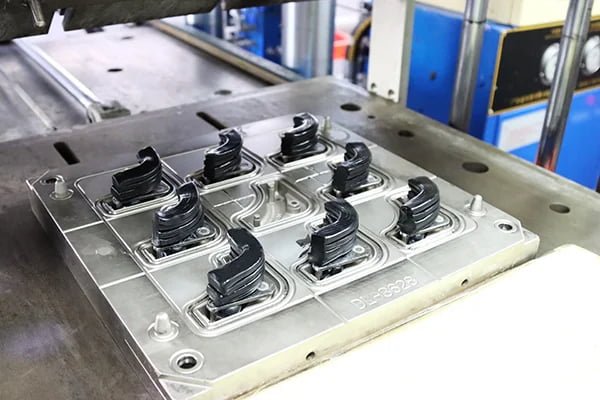
When a supplier quotes your project, they're making assumptions about mold structure that directly impact unit cost and production capacity. A single-cavity mold might cost $2,000–$5,000 and produce 500–800 pieces per day4. A four-cavity mold might cost $8,000–$15,000 and produce 2,000–3,200 pieces per day5.
If your initial order is 3,000 pieces with projected annual volume of 10,000 pieces, which tooling approach makes sense? A single-cavity mold keeps initial investment low but results in higher unit cost and longer production time. A multi-cavity mold requires larger upfront investment but dramatically reduces unit cost and cycle time.
I've learned to ask suppliers: "For my volume range, how many cavities would you recommend, and why?" Their answer reveals whether they're optimizing for your project economics or just trying to win the bid with a low sample quote.
Understand draft angles, undercuts, and parting line placement
Silicone molding requires draft angles to release parts from the mold6. Complex geometries with undercuts might require side-action mechanisms or post-molding assembly. Parting line placement affects both cosmetic appearance and dimensional accuracy.
When I'm evaluating whether a supplier understands design constraints, I ask: "Looking at this geometry, what concerns do you have about mold release or parting line placement?" If they point out potential issues and suggest design modifications, they're thinking through manufacturability. If they just say "no problem," they either haven't analyzed the design or they're avoiding difficult conversations.
Identify which tolerances actually matter for function
Brands often specify tight tolerances across the entire product when only certain dimensions affect function. Tighter tolerances increase inspection requirements, reject rates, and production cost. A supplier who accepts all your tolerances without question might not be thinking through the cost implications.
In projects I've managed, the best suppliers ask which dimensions are critical for fit, function, or assembly, and which are cosmetic. This conversation helps both parties understand where precision investment pays off and where looser tolerances reduce cost without affecting performance.
| Design Factor | Wrong Question | Right Question |
|---|---|---|
| Mold structure | "How much does the mold cost?" | "For my volume range, what cavity count optimizes unit economics?" |
| Complex geometry | "Can you make this shape?" | "What mold design features would this geometry require, and how do they affect cost?" |
| Tolerances | "Can you hit ±0.1mm?" | "Which dimensions affect function, and where can we relax tolerances to reduce cost?" |
| Surface finish | "Can you match this sample?" | "What texture or finish requires secondary operations, and what's the cost impact?" |
Why Is MOQ Structure More Important Than MOQ Number?
When brands see MOQ of 3,000 or 5,000 pieces, they often assume it's negotiable. "Can you do 1,000 pieces for the first order?" Sometimes suppliers say yes. But that "yes" often comes with hidden costs that appear later in the relationship.
MOQ isn't a pricing tactic—it's a structural indicator of how a factory's production model works. Understanding why a supplier sets their MOQ at a specific level tells you whether their operation matches your volume trajectory.
MOQ reflects production setup economics
Silicone molding requires machine setup, material preparation, color matching, mold installation, and first-article inspection before production starts. These setup costs are fixed per production run—they don't scale with order size.
If setup costs are $300–$500 per production run7, and you order 500 pieces, those costs add $0.60–$1.00 per piece to your unit cost. If you order 3,000 pieces, setup cost per piece drops to $0.10–$0.17. The supplier's MOQ reflects the volume where setup costs become acceptable as a percentage of total production value.
When I see a brand pushing for below-MOQ production, I ask them: "Are you willing to pay the higher unit cost that reflects setup cost distribution?" If not, we need to discuss order timing or multi-SKU batching to reach economic batch sizes.
Material batch minimums affect color consistency
Silicone compounds are mixed in minimum batches—often 25 kg to 50 kg depending on the compounder8. If your product weighs 50 grams and you order 500 pieces, you're consuming 25 kg of material—exactly one minimum batch.
But what happens when you reorder in three months? The factory orders another 25 kg batch from the compounder. Even with the same color formula, batch-to-batch variation means the second production run might have slightly different color tone than the first9.
Suppliers with higher MOQs often maintain buffer stock of custom color compounds or batch larger quantities to ensure color consistency across multiple production runs. When brands order below MOQ, they're trading batch cost efficiency for potential color matching challenges on reorders.
Multi-cavity molds create natural MOQ floors
If your product requires a four-cavity mold for economic production, and each machine cycle produces four pieces, the factory's production scheduling naturally aligns to cavity multiples. A production run of 3,000 pieces on a four-cavity mold requires 750 machine cycles.
A production run of 1,000 pieces requires 250 machine cycles—but the machine setup time, operator allocation, and quality inspection procedures are identical. From the factory's perspective, running 250 cycles versus 750 cycles costs almost the same in overhead, but generates only one-third of the revenue.
In projects I've handled, factories with flexible MOQs either accept lower margins on small orders (which affects their long-term commitment to your project) or they're planning to batch your order with other customers' production (which affects your lead time control).
What Questions Reveal a Silicone Manufacturer's Process Control Capability?
This is where I've learned the most from watching brand-supplier relationships succeed or fail. Brands assume sample approval derisks production, but samples are made under ideal conditions with maximum attention. Production happens under time pressure, with operator rotations, material batch variations, and equipment maintenance cycles.
The factories that deliver consistent production aren't necessarily the ones with the newest equipment or the most certifications—they're the ones with systematic approaches to detecting and correcting process variation before it reaches the customer.
Ask how they handle parameter drift during production
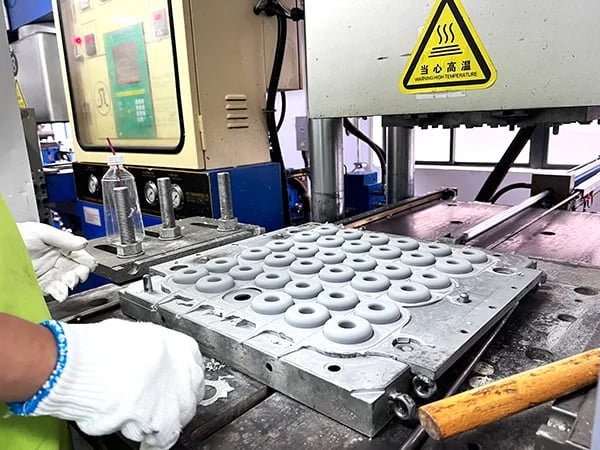
Silicone molding parameters—temperature, pressure, cure time—affect product properties and dimensional accuracy10. As machines run continuously, these parameters drift. The question isn't whether drift happens; it's how quickly the factory detects and corrects it.
When I'm screening a supplier's process control capability, I ask: "During a production run, what parameters do operators monitor, and how often? When measurements fall outside target range, what's the response procedure?"
Strong answers include specific parameters (cure temperature ±3°C, injection pressure ±5 bar), defined measurement intervals (every 30 minutes, every 50 cycles), and clear escalation procedures (operator adjusts machine, supervisor verifies, quality manager approves resume production).
Weak answers are vague: "We monitor everything carefully" or "Our operators are very experienced." Experience matters, but without systematic monitoring and documented response procedures, experience leads to inconsistent judgment calls.
Understand their incoming material inspection protocol
I've seen brands assume that because they specified approved material grades, the factory will use exactly that material throughout production. But silicone compounds arrive in drums from external suppliers, and not every factory verifies material properties before use.
When I'm assessing a supplier's material control, I ask: "What tests do you perform on incoming silicone compounds before releasing them to production? Do you track material lot numbers through production batches?"
Factories with robust material control perform basic verification tests—durometer hardness, viscosity checks, or visual inspection11—on every incoming batch. They reject material batches that fall outside specification, even from approved suppliers. They maintain lot traceability so if a customer reports a defect, they can identify which material batch was used and whether other orders used the same batch.
Factories with weak material control rely on supplier certifications without verification. They can't tell you which material lot went into which production batch, which makes root cause analysis nearly impossible when quality issues arise.
Identify how they validate new operators or production shifts
Operator skill affects cycle time optimization, defect detection, and machine adjustment decisions. Factories running multiple shifts or training new operators need systematic approaches to ensure consistent output across different teams.
In projects I've managed, I ask: "How do you validate that a new operator or a different shift can produce the same quality as your primary team?" Strong suppliers have qualification procedures: new operators produce sample batches under supervision, measurements are compared to established control limits, and operators must meet consistency standards before working unsupervised.
This question also reveals capacity constraints. If a factory runs only one shift with a small trained team, they might struggle to scale production during peak seasons or fulfill multiple customers' rush orders simultaneously.
| Process Control Factor | Signal of Weak Control | Signal of Strong Control |
|---|---|---|
| Parameter monitoring | "We check quality at the end" | "Operators measure X parameter every Y cycles" |
| Material verification | "We use certified suppliers" | "We test incoming batches and track lot numbers" |
| Operator validation | "Our workers are experienced" | "New operators must pass qualification with documented results" |
| Defect response | "We inspect carefully" | "When we see defect type X, we check parameters A, B, C" |
How Do You Match Your Project Requirements to Supplier Capabilities?
After years of watching brands select suppliers, I've noticed that project failures rarely stem from factories lacking certifications or equipment. They stem from mismatched expectations: a brand with complex design requirements chooses a supplier optimized for high-volume simple products, or a brand with growing but uncertain volumes chooses a supplier with rigid high-MOQ structures.
The goal isn't to find the "best" silicone OEM manufacturer in China—it's to find the supplier whose production model, capacity structure, and quality systems align with your specific project trajectory.
Map your design complexity to supplier tooling experience
If your product has simple geometry (kitchen utensils, sealing rings, protective caps), most competent silicone manufacturers can execute the project. Your selection criteria should emphasize cost efficiency, capacity flexibility, and material sourcing.
If your product has complex geometry (multi-part assemblies, insert molding, overmolding on rigid components), you need suppliers with advanced mold design experience, precision machining capabilities, and process engineers who understand tolerance stack-up.
I've seen brands with complex designs choose suppliers based on price quotes, only to discover the supplier lacks the tooling expertise to solve mold release issues, parting line placement challenges, or dimensional control problems. By the time these issues surface—often after mold payment—the brand has limited leverage to switch suppliers without restarting the entire project.
Align your volume trajectory with supplier MOQ structure
If you're launching a new product with uncertain demand, you need a supplier who can support test-market volumes (1,000–3,000 pieces) without penalizing unit cost excessively, and who can scale efficiently when demand grows.
If you're replacing an existing product with established demand, you should optimize for unit cost efficiency with multi-cavity tooling and higher MOQs that reduce per-piece costs.
The mismatch I see most often: brands launching new
"How Much Does Custom Silicone Manufacturing Cost ...", https://www.newtopsilicone.com/custom-silicone-manufacturing-cost/. Industry analyses of silicone molding economics identify cavity count, cure time, and material utilization as primary cost drivers, with multi-cavity tooling reducing per-unit costs by distributing fixed setup expenses across higher output volumes. Evidence role: mechanism; source type: research. Supports: the relationship between mold cavity count, cure time, and production economics in silicone molding. Scope note: while general molding economics are well-documented, specific cost relationships vary by product geometry and production scale ↩
"Inventory of Food Contact Substances Listed in 21 CFR", https://www.hfpappexternal.fda.gov/scripts/fdcc/index.cfm?search=silicone&set=IndirectAdditives. The U.S. Food and Drug Administration regulates food-contact substances under 21 CFR, with silicone rubber articles for food contact required to comply with specifications in 21 CFR 177.2600, though facility registration requirements depend on the manufacturer's role in the supply chain. Evidence role: general_support; source type: government. Supports: FDA regulatory requirements for food-contact silicone materials. Scope note: FDA registration requirements differ for material manufacturers, fabricators, and importers, and the article's claim about registration may conflate material compliance with facility registration ↩
"Legal regulations for safe food", https://www.bundesumweltministerium.de/en/topics/health/food-safety/legal-regulations-for-safe-food. The German Food and Feed Code (LFGB) establishes requirements for food-contact materials sold in Germany, while EU Regulation 1935/2004 provides the overarching framework for food-contact materials across European markets, with LFGB testing often used as a compliance benchmark beyond Germany. Evidence role: definition; source type: government. Supports: the regulatory framework for food-contact materials in European markets. Scope note: LFGB is specifically German legislation, not a pan-European standard, though it is widely recognized in European trade ↩
"How much does it cost to make a custom silicone mold?", https://jcadusa.com/how-much-does-a-custom-silicone-mold-cost-to-make/. Manufacturing industry references indicate that simple single-cavity silicone molds typically range from $2,000 to $5,000 in tooling costs, with daily production capacity varying based on part complexity and cure time requirements. Evidence role: statistic; source type: research. Supports: typical cost ranges and production rates for single-cavity silicone molds. Scope note: actual costs and production rates depend heavily on part geometry, material specifications, and facility capabilities ↩
"Multi Cavity Silicone Molds - Etsy - Page 2", https://www.etsy.com/market/multi_cavity_silicone_molds?page=2. Industry tooling cost analyses show that four-cavity silicone molds generally require $8,000 to $15,000 in initial investment, with production capacity scaling approximately linearly with cavity count when cycle times remain constant. Evidence role: statistic; source type: research. Supports: cost ranges and production capacity for multi-cavity silicone molds. Scope note: these figures represent typical ranges for standard geometries and may vary significantly with design complexity and precision requirements ↩
"Draft Angle Guidelines for Injection Molding - Protolabs", https://www.protolabs.com/resources/design-tips/improving-part-moldability-with-draft/. Engineering design guides for injection molding specify that draft angles facilitate part ejection from mold cavities by reducing friction between the part surface and mold walls, with silicone's flexibility allowing for smaller draft angles than rigid plastics. Evidence role: mechanism; source type: education. Supports: the technical requirement for draft angles in silicone molding processes. ↩
"A Comparative Investment Analysis of Batch Versus Continuous ... - PMC", https://pmc.ncbi.nlm.nih.gov/articles/PMC8802271/. Manufacturing cost analyses indicate that setup costs for silicone molding operations, including machine preparation, material loading, color matching, and first-article inspection, typically range from $300 to $500 per production run depending on part complexity and facility labor rates. Evidence role: statistic; source type: research. Supports: typical setup cost ranges for silicone molding production runs. Scope note: actual setup costs vary significantly based on product complexity, color requirements, and regional labor costs ↩
"Silicone Rubber Procedure — Creative Soft Robotics - Spring 2026", https://courses.ideate.cmu.edu/16-480/s2026/text/hardware/procedure.html. Silicone material suppliers typically specify minimum order quantities of 25 to 50 kilograms for custom-colored or custom-formulated compounds, reflecting the economics of mixing equipment setup and quality control testing requirements. Evidence role: general_support; source type: research. Supports: typical minimum batch sizes for silicone compound mixing. Scope note: minimum batch sizes vary by supplier, compound type, and whether the formulation is standard or custom ↩
"Identification of colored-masterbatch process-parameter with greater ...", https://www.academia.edu/10995195/Identification_of_colored_masterbatch_process_parameter_with_greater_influence_on_pigment_dispersion_and_color_perception. Materials science literature on polymer compounding identifies batch-to-batch color variation as resulting from differences in pigment dispersion, raw material lot variations, and mixing process parameters, with color matching tolerances typically specified using standardized color difference measurements. Evidence role: mechanism; source type: research. Supports: the causes of color variation between batches in silicone compound production. ↩
"Effect of the cure time on the Mechanical Properties of Silicone ...", https://ui.adsabs.harvard.edu/abs/2022E&ES..961a2100H/abstract. Polymer processing research demonstrates that silicone molding parameters including cure temperature, injection pressure, and cure time directly influence cross-link density, mechanical properties, dimensional stability, and surface finish, with parameter control critical for consistent product quality. Evidence role: mechanism; source type: research. Supports: how molding process parameters influence silicone product characteristics. ↩
"Incoming Quality Inspection", https://www.rtdygert.com/incoming-quality-inspection.html. Quality control protocols for silicone materials commonly include durometer hardness testing to verify Shore A hardness specifications, viscosity measurements for liquid silicone rubber to ensure processability, and visual inspection for contamination or separation, providing rapid verification of material conformance. Evidence role: general_support; source type: research. Supports: common incoming inspection methods for silicone compounds in manufacturing. ↩
Добавить комментарий