

Silicone Hardness Guide: Shore A for Food Molds
Silicone hardness Shore A is the one number that decides whether a food mold releases cleanly or tears at the rim on the third demold. It is also the number most buyers copy from a competitor's data sheet instead of deriving from their own part. This guide gives the ranges that actually work by application, and the reasoning behind each one.
Silicone hardness Shore A for food-grade silicone molds almost always sits between 20A and 80A. Below 20A the cavity is too soft to hold its shape under batter or molten chocolate. Above 80A the mold stops flexing enough to release anything with an undercut. Inside that band, four things decide the number: cavity depth, detail size, demold method, and the temperature the mold runs at.
What Shore A Actually Measures
Silicone hardness Shore A is a measure of indentation resistance — not stiffness, not density, not "softness" in the everyday sense. A spring-loaded indenter is pressed into the material and the penetration depth is read on a 0–100 scale.
Three consequences follow, and each one costs money when it is ignored.
One reading is not the number. The indenter keeps sinking for a few seconds after contact. A reading taken at one second and a reading taken at fifteen seconds are different values, and standards differ on which one is required. Always state the dwell time when you compare two data sheets.
The tolerance is ±5A. A compound sold as 40A is compliant anywhere from 35A to 45A. That is a full application band's worth of variation. If your chocolate mold needs 30A–35A, write the tolerance into the purchase order instead of accepting "40A" as a single point.
The scale ends are not usable. Above roughly 90A the Shore A reading loses resolution and the industry switches to Shore D. Below roughly 10A it switches to Shore 00.
| Scale | Working range | Where it is used |
|---|---|---|
| Shore 00 | very soft, below the A range | gels, soft-touch pads |
| Shore A | 10A–90A | food molds, seals, keypads, sleeves |
| Shore D | above 90A | rigid plastics, not molded silicone |
One citation point worth fixing on most supplier data sheets: ISO 868 is the plastics and ebonite method. For vulcanized silicone rubber the durometer method is ASTM D2240 or ISO 48-4. The indenter family is the same, so the numbers are broadly comparable, but if your compliance file names a test method, name the rubber one.
Silicone Hardness Shore A Chart by Application
The table below is the short answer — the silicone hardness Shore A range for each food application, and what fails outside it. The section after it explains why each range sits where it does.
| Application | Recommended Shore A | Deciding factor | What fails outside the range |
|---|---|---|---|
| Chocolate, thin shells and bars | 25A–35A | Fine logo and surface detail release | Too hard: detail chips. Too soft: shells warp |
| Chocolate, deep shells and pralines | 30A–35A | Wall support during demold | Softer than 30A and the shell collapses |
| Fondant and sugar paste | 20A–40A | Gentle release of soft, sticky mass | Harder grades mark the surface |
| Gummy and jelly | 30A–50A | Demold force on a tacky part | Under 30A: cavities deform. Over 50A: parts tear |
| Gummy on automated depositors | 40A–50A | Repeatability across thousands of cycles | Soft grades wear at the cavity mouth |
| Hard candy and lollipop | 30A–50A | Heat resistance plus release | Soft grades lose shape at pouring temperature |
| Baking: muffin, loaf, cake | 50A–70A | Batter weight support | Under 50A: walls bow outward in the oven |
| Baking mats and sheets | 60A–70A | Flatness and dimensional stability | Soft sheets ripple and trap batter |
| Ice and freezer molds | 30A–50A | Release after cold stiffening | Above 50A the mold is too stiff to demold a frozen block |
| Butter, cheese, pastry | 40A–60A | Balance of detail and support | Too soft: portion edges smear |
Application Notes: Why Each Range Sits Where It Does
Chocolate and Fondant Molds: 20A–40A
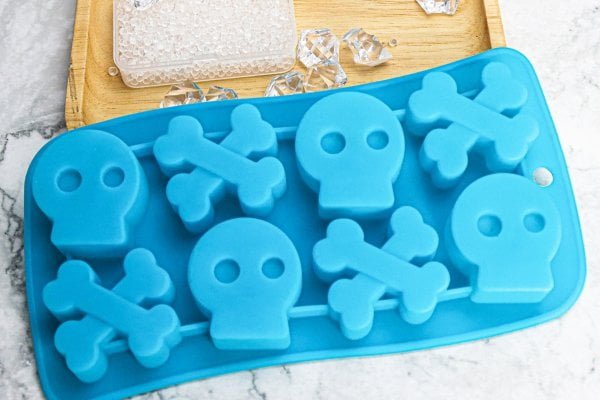
Chocolate work is a detail problem, not a structural one. A 30A mold picks up a 0.2 mm logo edge and releases it without a release agent, which is why cavity detail drives the choice more than part size. The exception is the deep praline shell: at 25A the sidewall folds inward when the mold is inverted, so deep cavities move up to 30A–35A. If the mold runs on a vibrating table to knock out bubbles, stay at the harder end of the band.
Gummy and Jelly Molds: 30A–50A
Silicone hardness Shore A for gummies sits at 30A–50A because the failure mode is tearing rather than sticking: the parts are tacky and stretch before they release. Below 30A the cavity mouth deforms under the demold pull and the part comes out with a rounded edge instead of a crisp one. Above 50A the demold force climbs and thin ears tear. On automated depositors the practical answer is 40A–50A, because the cavity has to survive tens of thousands of cycles without the mouth wearing oval.

Baking Molds: 50A–70A
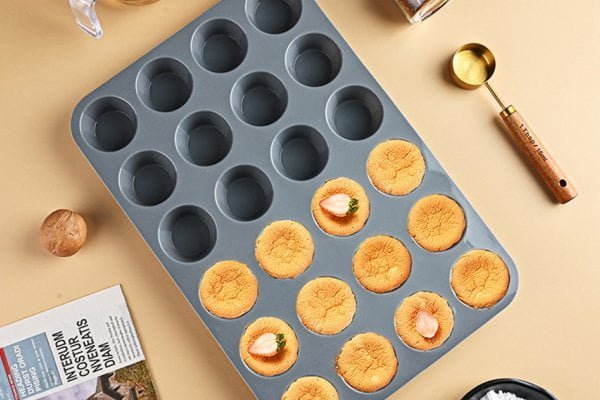
Baking pushes silicone hardness Shore A higher than any other food application, because batter is heavy and the oven is hot. A muffin or loaf cavity has to hold a vertical wall against several hundred grams of batter at 180–220°C, and that is a stiffness requirement, not a release requirement. Below 50A the walls bow and the base cups. Baking mats sit higher at 60A–70A because flatness matters more than release. If the same mold is used for both baking and freezing, specify for the hot case and accept the cold stiffness. Mats at this hardness also survive dishwasher cycles without edge curl; our guide to cleaning silicone molds covers the routine.
Ice and Freezer Molds: 30A–50A
Silicone hardness Shore A rises in the cold — roughly +5A to +10A at −18°C — and the shift reverses when the mold returns to room temperature. This is why ice molds are specified softer than their room-temperature job would suggest: a 45A mold that feels right on the bench behaves like 50A–55A when you are twisting an ice block out of it. Water also expands as it freezes, so the cavity is under load before the demold even starts.
Soft vs Hard: The Engineering Trade-off
Silicone hardness Shore A is not a quality scale. Every step up buys support and costs release; every step down buys detail and costs durability.
| Property | 20A–30A | 40A | 60A | 70A–80A |
|---|---|---|---|---|
| Detail reproduction | Best | Very good | Good | Fair |
| Release on thin undercuts | Effortless | Easy | Firm pull needed | Difficult |
| Tear resistance | Faible | Moderate | High | High but less forgiving in flex |
| Support for heavy batter | Poor | Fair | Good | Best |
| Compression set under heat | Worst | Moderate | Good | Best |
| Shape retention after repeated cycles | Poorest | Fair | Good | Best |
The practical rule for food molds: pick the softest grade that still holds the cavity shape at service temperature. Going harder "for durability" is the most common way to ruin a chocolate mold.
Temperature Moves the Number More Than Buyers Expect
Two effects run in opposite directions on silicone hardness Shore A, and both matter for food work.
Cold raises hardness. At freezer temperature the same compound reads several points harder, which is why the ice mold band above is set low.
Heat and time raise it too, but permanently. Repeated cycles above 200°C accelerate polymer aging: the mold slowly hardens, loses elongation and eventually cracks at the cavity edge. A post-cure of about four hours at 200°C, done at the factory before shipment, drives off volatiles and stabilises the part so the number you approve is the number you keep. Skipping post-cure on a food mold is a false economy — it usually shows up as extractables and a hardness drift in the first month.
Hardness, Shrinkage and Wall Thickness
Silicone hardness Shore A and shrinkage are related but not interchangeable. Higher durometer compounds carry more filler, and filler loading usually reduces shrinkage — but the governing number is the compound's own TDS value, not a rule of thumb. Two 50A compounds from different suppliers can differ by several tenths of a percent, which is enough to matter on a 150 mm cavity.
Wall thickness works the other way: thin walls heat and cool faster, cure differently, and pick up dimensional drift that reads like a hardness problem during demold. If a part releases badly only in some cavities, check wall thickness variation before you change the compound. Our silicone mold shrinkage guide covers how to build that allowance into the tool.
Dual-Durometer Molds: Rigid Frame, Soft Cavity
A single mold can carry two silicone hardness Shore A values. The typical food-mold layout is a 60A–70A outer frame for handling and dimensional stability, with a 25A–30A cavity face for detail and release. Deep praline molds and large baking trays are the usual candidates.
The process is liquid silicone rubber multi-shot: two compounds are injected into defined zones of the same tool, with a controlled bond at the interface. It demands precise parting line design, gate placement and material compatibility, and it costs meaningfully more than a single-hardness tool. It is worth it when the part needs both a crisp cavity face and a frame that will not flop — not as a general upgrade.
Five Selection Mistakes and How to Avoid Them
| Mistake | What happens | Fix |
|---|---|---|
| Specifying 20A for a deep baking cavity | Walls collapse when the batter goes in | Move to 50A–60A, or redesign the cavity |
| Using 70A for fine chocolate detail | Logos chip at demold | 30A–35A, and check the draft angle |
| Quoting the room-temperature number for a freezer mold | Mold feels far too hard at −18°C | Specify about 10A softer than the bench equivalent |
| Treating "food grade" as a complete spec | Compliance is met, performance is not | Food contact status and hardness are two separate lines on the PO |
| Mixing compound lots in one production run | Demold results vary cavity to cavity | One lot per run, plus incoming durometer checks |
There is no universal silicone hardness Shore A value — only the one that fits a specific part, mold and process. Any supplier who quotes a food mold without asking about cavity depth and demold method is guessing.
Specifying Silicone Hardness Shore A at the DFM Stage
Hardness should be locked before steel is cut, because changing it afterwards means changing the cavity allowance as well. A useful DFM review covers:
- Cavity depth and draft — deep cavities need support; shallow drafts need flex
- Detail size — the smallest feature that must reproduce cleanly
- Undercuts — how much stretch the part can take before it tears
- Demold method — by hand, by air assist, or by robot
- Service temperature — oven, freezer, or both
- Annual volume — cycle life becomes a hardness argument at scale
- Compliance target — FDA 21 CFR 177.2600 for the US, EU 10/2011 for Europe, LFGB for Germany
- Sample plan — trial at two hardnesses, not one
Soft-tool sampling at 30A and 50A, or 40A and 60A, settles in an afternoon what a data sheet argument cannot. Our DFM checklist for custom silicone molds lists the other eight items worth reviewing at the same time, and the material side is covered in our HTV silicone guide.
Note that food contact compliance and hardness are independent variables. A compound can be fully compliant and completely wrong for your part. The FDA regulation on rubber articles for repeated use and the EU food contact material rules define what may be in the material; they say nothing about whether 40A will release your gummy.
How to Verify the Hardness You Receive
Verifying silicone hardness Shore A means not accepting a certificate as proof of the part in the box. A durometer costs little and settles the question in a minute.
- Measure on a flat area at least 6 mm thick — never on a rib, a curved rim or a textured face
- Take five readings across the part and average them; discard any reading within 12 mm of an edge
- Use the same dwell time your supplier used, or the comparison is meaningless
- Check the first article, then spot-check each lot
- Record the reading against the compound TDS, not against the drawing
The test method itself is defined in ASTM D2240 for rubber durometer work; the ISO 868 page describes the equivalent plastics and ebonite method.
Frequently Asked Questions
Is 40A or 50A better for gummy molds?
Silicone hardness Shore A for gummies depends on how the mold is used. Hand-demolded gummies are comfortable at 40A, which gives enough flex to peel the part out without tearing a thin ear. Automated depositors usually run 40A–50A because the cavity mouth has to survive tens of thousands of cycles without wearing oval. If your gummies have fine facial detail, stay at 40A and fix the tear problem with draft and edge radius instead of hardness.
Does silicone hardness change in the freezer?
Yes, temporarily. At −18°C a silicone mold reads roughly 5A to 10A harder than at room temperature, and the shift reverses once it warms up. This is why ice and freezer molds should be specified about 10A softer than the room-temperature equivalent, and why a 45A mold can feel unpleasantly stiff when you are twisting out an ice block.
Can I measure hardness on a finished molded part?
Only if the part has a flat area at least 6 mm thick. Curved rims, ribs, thin walls and textured faces all read low because the material deflects under the indenter rather than resisting it. For thin parts, mold a test plaque in the same compound and lot, and measure that instead — then keep the plaque with the lot records.
What is the difference between Shore A and Shore D?
Both use the same spring-loaded indenter principle with different spring forces and tip geometry. Shore A covers softer elastomers from about 10A to 90A; Shore D covers harder materials from about 40D upward. Food molds live entirely in Shore A. Above roughly 90A the A scale loses resolution, which is why the industry switches scales rather than quoting 95A.
Is harder silicone more durable for food molds?
Not in the way buyers usually mean. Higher hardness resists compression set and holds shape better, but it also raises demold force, and demold force is what tears parts. A 70A chocolate mold will outlast a 30A one in the press and still ruin more product, because the failure happens at the part, not the mold. Match hardness to the part first, then buy durability through compound quality and post-cure.
Can one mold have two different hardnesses?
Yes — dual-durometer molding injects a soft compound into the cavity face and a harder compound into the frame of the same tool. It is common in deep praline molds and large baking trays, where the cavity needs detail and the frame needs rigidity. It requires liquid silicone injection, precise gate and parting line design, and a higher tooling budget.
Conclusion
Choosing silicone hardness Shore A is a short decision with a long tail: a handful of points on a scale, fixed by cavity depth, detail size, demold method and service temperature. Get it right at DFM and the mold runs for years. Get it wrong and every symptom — warped shells, torn ears, bowed cake walls, ice blocks that will not release — looks like a different problem.
Send us the part drawing, the application and the service temperature. We will come back with a recommended range, the tolerance to write into the PO, and two sample hardnesses to trial before you commit to tooling.
About the Author & Dibo Tech
My name is Kunfa Ye, but friends call me Jeff. I was born in 1986, the year of the Tiger. In 2011, my brother Autumn Ye and I co-founded Dibo Tech, rooting ourselves in the silicone rubber industry for fifteen years. Building from scratch, we navigated industry cycles and learned the true rewards of hard work. We have always built our business on technical expertise and integrity.
The silicone industry touches every corner of modern manufacturing. I deeply believe that behind every product lies trust, and the essence of business is mutual gain. Over these years, my proudest achievement is not personal financial independence, but helping our clients optimize supply chains and boost production efficiency. Their success is far more rewarding than personal milestones. Today, I aim to give back by sharing insights, answering engineering questions, and connecting resources.
Brand Name: Dibo Tech Slogan: Dibo Technology Silicone Manufacturing Specialists Website: https://samxine.com/ Our Mission: Based on strong technical capabilities and quality first, we are committed to innovative and eco-friendly silicone rubber production, providing reliable silicone solutions while fulfilling social responsibilities for a sustainable future.
Need help specifying silicone hardness for your next food mold? Send us your 3D drawing for a free DFM review and hardness recommendation.
Laisser un commentaire