

Which countries are the biggest producers of silicone?
Which countries are the biggest producers of silicone?
Global manufacturing has transformed dramatically over the past three decades. Buyers searching for reliable silicone suppliers1 face a confusing landscape — production has concentrated in specific regions, quality varies wildly, and supply chain decisions carry enormous weight. I've watched clients struggle with this exact problem: they need シリコーン製品2, but don't know where the production actually happens or which regions offer the best combination of capability, cost, and quality assurance.
China dominates global silicone and silicone rubber products production, particularly through the Dongguan manufacturing hub in Guangdong Province. Germany and the United States maintain significant production capacity focused on specialty silicones and raw material synthesis, while South Korea and Japan contribute advanced manufacturing expertise. Approximately 60-70% of finished silicone products now originate from Chinese facilities3, with Dongguan alone housing thousands of silicone product manufacturers4 across every conceivable process type — from compression molding to liquid injection molding to extrusion5.
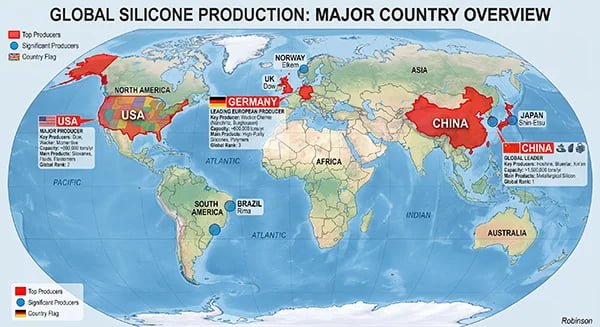
Understanding production geography matters more than most procurement teams realize. The country of origin affects lead times, quality control systems, compliance documentation, intellectual property protection, and total landed cost. I've seen purchase orders succeed brilliantly and fail spectacularly based purely on selecting the right production region for specific product requirements.
Why does China produce most of the world's silicone products?
China captured global silicone production leadership through deliberate industrial policy, infrastructure investment, and manufacturing ecosystem development. The concentration isn't accidental — it resulted from coordinated advantages that competitors couldn't replicate.
China produces 60-70% of finished silicone products globally due to integrated supply chains, specialized labor pools, equipment manufacturing proximity, and government-supported industrial zones. Dongguan specifically developed as a silicone manufacturing center because it combines raw material access, tooling expertise, quality testing facilities, and export infrastructure within a 50-kilometer radius.
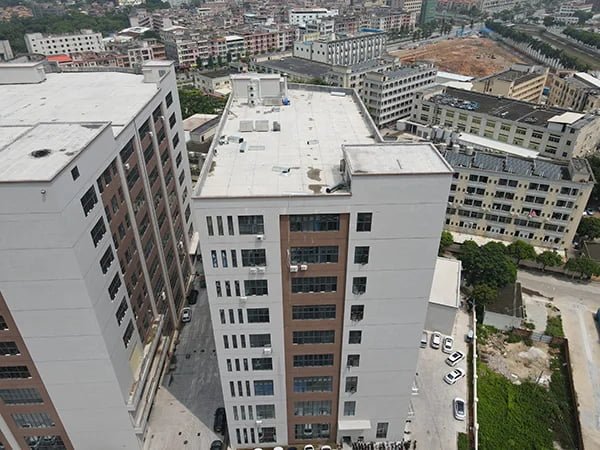
The Dongguan advantage explained
Dongguan transformed from agricultural land to manufacturing powerhouse in roughly 25 years6. I've visited the region multiple times, and the scale remains impressive even after you've seen it — entire districts devoted to silicone product manufacturing, with supporting industries clustered around them.
The ecosystem works like this:
Raw material suppliers maintain local warehouses stocked with various silicone grades. Manufacturers can source material with same-day delivery, eliminating inventory carrying costs and enabling rapid product development cycles.
Mold and tooling shops operate within the same industrial parks as production facilities. A manufacturer can design a product on Monday, commission tooling on Tuesday, and run first articles by Friday. This compression molding or liquid injection molding speed creates enormous competitive advantages.
Quality testing laboratories offer third-party verification services. Manufacturers send samples for ROHS testing, FDA compliance verification, mechanical property testing, or biocompatibility screening without shipping internationally.
Process specialization developed naturally. Some facilities focus exclusively on compression molding for automotive parts. Others specialize in liquid silicone rubber (LSR) injection for medical devices. Still others handle only extrusion processes for seals and gaskets. This specialization drives quality improvements and process optimization.
Manufacturing scale and diversity
The number of silicone manufacturers in Dongguan ranges from small family operations running 5-10 compression molding machines to massive facilities with 200+ injection molding machines running 24/7. This diversity matters for buyers:
| Manufacturer Size | Typical Capabilities | Best For |
|---|---|---|
| Small (10-50 employees) | 5-20 machines, flexible on small runs | Custom prototypes, specialized products, orders under 10,000 units |
| Medium (50-200 employees) | 20-80 machines, balanced capacity | Standard products, 10,000-100,000 unit runs, reasonable flexibility |
| Large (200+ employees) | 80-200+ machines, high automation | Mass production, 100,000+ units, stable specifications |
I work with medium-sized manufacturers because they balance capability with responsiveness. Large facilities offer attractive per-unit costs but struggle with smaller orders or specification changes. Small operations provide excellent service but lack capacity for scaling successful products.
The complete supply chain ecosystem
Beyond manufacturing, Dongguan developed supporting industries that complete the value chain:
- Silicone raw material production facilities within Guangdong Province
- Platinum catalyst suppliers for LSR processes
- Color masterbatch manufacturers for custom color matching
- Packaging material suppliers for retail-ready packaging
- Freight forwarders specializing in silicone product export
- Compliance testing services familiar with international standards
- Product design consultants experienced with silicone material properties
This ecosystem means a buyer can move from concept to shipping container without coordinating across multiple regions. Everything happens within a 100-kilometer radius.
Which other countries maintain significant silicone production capacity?
While China dominates finished product manufacturing, other countries maintain strategic production capabilities focused on specific market segments or supply chain positions.
Germany, the United States, South Korea, and Japan maintain significant silicone production focused on specialty applications, raw material synthesis, and high-end manufacturing. Germany leads European production with approximately 8-10% global market share7, concentrated in raw silicone polymer production and industrial specialty products. The United States maintains roughly 10-12% global capacity8, primarily in raw material production and aerospace-grade specialty silicones.

Germany's chemical industry leadership
German silicone production concentrates in the raw material and specialty industrial segments. Major chemical producers maintain silicone polymer production facilities that supply manufacturers globally.
German production advantages include:
Technical innovation: German chemical companies pioneered many silicone formulations and continue developing specialty grades for demanding applications. When you need a silicone that withstands 300°C continuously or resists specific chemical exposures, German-developed materials often provide the solution.
Quality systems: German manufacturers built reputations on consistent material properties and comprehensive documentation. Their quality management systems satisfy aerospace, automotive, and medical device requirements without additional qualification work.
European market access: Manufacturers serving European customers benefit from local production that simplifies REACH compliance9, reduces shipping times, and minimizes currency exposure.
However, German production costs run 3-5 times higher than Chinese equivalents10. This cost differential limits German production to applications where material performance justifies premium pricing.
United States production and specialization
American silicone production split into two distinct categories:
Raw material production: Large chemical companies operate facilities producing silicone polymers, particularly specialty grades for aerospace, defense, and medical applications. These facilities supply manufacturers globally but focus on high-value formulations.
Specialty finished products: Smaller manufacturers produce silicone products for applications requiring domestic production — defense contracts, FDA-regulated medical devices, or products where intellectual property protection outweighs cost considerations.
The U.S. market dynamics differ from Chinese manufacturing:
| アスペクト | United States | China |
|---|---|---|
| [Labor costs | $25-45/hour loaded | $5-8/hour loaded](https://www.bls.gov/eci/)%%%FOOTNOTE_REF_11%%% |
| Minimum order quantities | Higher (5,000-10,000 units) | Lower (1,000-5,000 units) |
| Lead times | 8-12 weeks typical | 4-6 weeks typical |
| Tooling costs | $5,000-20,000 | $1,000-5,000 |
| Quality systems | ISO 13485, AS9100 common | ISO 9001 standard, others available |
I've worked with American manufacturers on FDA Class II medical devices where the compliance documentation justified domestic production. For commercial products without regulatory constraints, the cost differential made Chinese manufacturing the only economically viable option.
Asian production beyond China
South Korea and Japan maintain specialized silicone manufacturing capabilities:
South Korea produces approximately 5-7% of global silicone products, concentrated in electronics applications and automotive components. Korean manufacturers excel at precision molding and maintain close relationships with electronics brands.
Japan focuses on high-performance specialty silicones, particularly for automotive and consumer electronics applications. Japanese material science expertise continues driving innovation in silicone formulations.
Both countries face similar challenges: high labor costs, limited scale compared to Chinese competitors, and difficulty competing on standard commercial products. They survive by focusing on technical applications where their expertise and quality systems justify premium pricing.
How has silicone production geography shifted over recent decades?
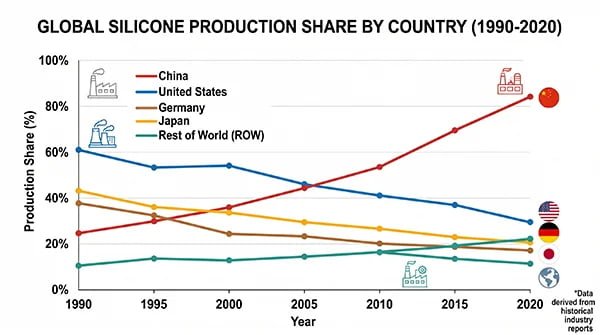
Global silicone production consolidated dramatically since 1990. Understanding this shift helps buyers anticipate future supply chain changes and position their sourcing strategies appropriately.
Silicone production shifted from distributed Western manufacturing to concentrated Asian production between 1990-2020, with China's share growing from roughly 10% to 60-70% of global finished products. This consolidation resulted from comparative advantage in labor costs, deliberate Chinese industrial policy, and Western manufacturers' strategic retreat from commodity silicone production toward specialty applications.
The 1990s foundation period
In 1990, silicone production distributed across North America, Europe, and Japan. Manufacturing remained geographically close to end customers, with regional production serving regional markets.
China operated as a low-cost assembly location, producing simple compression-molded products under foreign supervision. Technical capabilities remained limited. Quality control systems were nascent. Most Chinese facilities operated as contract manufacturers for Hong Kong trading companies rather than independent producers.
The 2000s acceleration phase
China's WTO accession in 2001 accelerated manufacturing migration12. Several factors converged:
Technology transfer: Western companies established Chinese joint ventures, transferring process knowledge and quality systems. These partnerships trained a generation of Chinese engineers and technicians in modern silicone manufacturing.
Equipment availability: European and American equipment manufacturers sold production machinery to Chinese buyers. Access to modern compression molding presses, injection molding machines, and extrusion lines eliminated the technology gap.
Raw material localization: Chemical companies built silicone polymer production facilities in China, eliminating import logistics and reducing raw material costs.
Quality system development: Chinese manufacturers adopted ISO 9001 systems, implemented statistical process control, and began satisfying international quality requirements.
By 2010, Chinese manufacturers could produce most standard silicone products at quality levels matching Western competitors, but at 40-60% lower total costs.
The 2010s consolidation phase
Western manufacturers made strategic decisions during this decade:
Retreat from commodity products: American and European facilities closed production lines for standard silicone products, focusing remaining capacity on specialty applications, medical devices, aerospace components, and products requiring domestic production for regulatory or customer requirements.
Raw material focus: Chemical companies maintained silicone polymer production but allowed finished product manufacturing to migrate to Asia. This preserved their high-value position in the supply chain while acknowledging cost realities in product manufacturing.
Design and engineering retention: Western companies retained product development, testing, and technical service capabilities even as production moved. This preserved intellectual property and customer relationships while reducing manufacturing cost structures.
Chinese manufacturers simultaneously moved upmarket:
- Adopted liquid silicone rubber (LSR) injection molding technology
- Developed clean room manufacturing for medical devices
- Implemented advanced quality control systems
- Obtained international certifications (ISO 13485, IATF 16949, etc.)
- Built independent design and engineering capabilities
Current state and future trends
Today's silicone production landscape features:
Chinese dominance in finished products: Most commercial silicone products — kitchenware, consumer goods, industrial components, basic seals and gaskets — now come from Chinese manufacturers. The cost advantage remains insurmountable for standard products.
Western specialty focus: German, American, and Japanese production concentrates on applications where material performance, regulatory requirements, intellectual property concerns, or customer specifications justify premium costs.
Supply chain diversification pressure: Recent geopolitical tensions and pandemic disruptions pushed some buyers toward supply chain diversification. However, alternative manufacturing locations (Vietnam, Thailand, Malaysia) lack the integrated ecosystem that makes Chinese production efficient.
Automation impact: Increased automation reduces labor cost advantages, but Chinese manufacturers adopt automation faster than Western competitors, maintaining their cost position even as labor productivity increases.
Looking forward, I expect Chinese production dominance to continue for standard commercial products. Western production will survive in protected niches — defense, aerospace, specialty medical devices, and applications where domestic production provides strategic advantages. Buyers should plan sourcing strategies assuming this bifurcated market continues for at least another decade.
What production capabilities should buyers evaluate by country?
Different countries excel at specific manufacturing processes and product types. Smart buyers match their product requirements to regional strengths rather than forcing production into unsuitable locations.
Evaluate production locations based on process requirements, quality system needs, volume expectations, and total landed cost. Chinese manufacturers excel at high-volume compression molding, extrusion, and increasingly LSR injection molding across all quality levels. German and American facilities specialize in low-volume, high-complexity products requiring advanced quality systems, specialty material formulations, or demanding regulatory compliance.
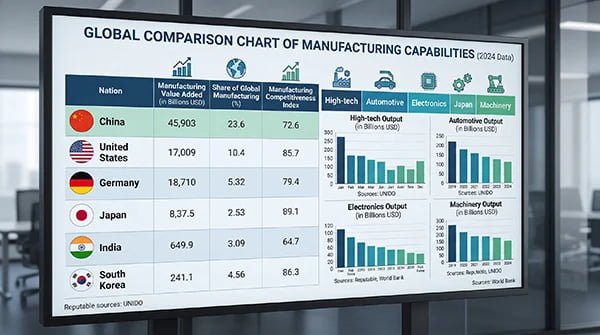
Process capability assessment
Different processes suit different production regions:
Compression molding: China offers overwhelming advantages. The process remains labor-intensive, Chinese manufacturers maintain extensive equipment capacity, and tooling costs run 50-70% lower than Western equivalents. Unless specifications require domestic production, Chinese compression molding makes economic sense for virtually all applications.
Liquid silicone rubber (LSR) injection molding: China developed strong LSR capabilities over the past decade. Modern Chinese facilities rival Western competitors in process control, cycle time optimization, and quality consistency. German and American manufacturers maintain advantages in extremely tight tolerances or multi-cavity tooling for medical devices, but Chinese facilities handle most LSR applications competently.
Extrusion: Chinese manufacturers dominate standard extrusions — seals, gaskets, tubing, weatherstripping. Western manufacturers produce specialty extrusions requiring unusual material formulations or extremely tight dimensional tolerances, but represent a tiny market fraction.
Specialty processes: Over-molding, insert molding, two-shot molding, and complex assembly operations work well in China due to labor cost advantages. These processes require operator skill and quality attention that Chinese manufacturers now provide routinely.
Quality system considerations
Match required quality systems to regional capabilities:
| Quality System | China | Germany | United States |
|---|---|---|---|
| ISO 9001 | Widely available | Universal | Universal |
| ISO 13485 (Medical) | Growing availability | Common | Common |
| IATF 16949 (Automotive) | Major manufacturers | Universal automotive suppliers | Universal automotive suppliers |
| AS9100 (Aerospace) | Rare | Available | Common |
| FDA registration | Available from serious manufacturers | Universal | Universal |
Chinese manufacturers pursuing international customers typically maintain ISO 9001 certification and can provide compliance documentation for standard requirements. Medical device and aerospace applications still favor Western manufacturers due to established quality systems and regulatory relationships.
Volume and flexibility trade-offs
Production volume dramatically affects optimal sourcing locations:
Low volume (under 5,000 units): Chinese manufacturers offer the best combination of reasonable tooling costs and acceptable per-unit pricing. Western manufacturers struggle with small volumes due to high overhead costs.
Medium volume (5,000-100,000 units): China provides clear advantages. Manufacturers efficiently handle these volumes, offer competitive pricing, and maintain sufficient capacity for reasonable lead times.
High volume (100,000+ units): Chinese manufacturers excel at high-volume production. Tooling gets amortized across large production runs, material buying power reduces costs, and dedicated production lines optimize efficiency.
Flexibility requirements: Chinese manufacturers, particularly medium-sized facilities, typically accommodate specification changes, color variations, and custom packaging more readily than Western facilities operating on tighter margins. This flexibility matters during product development or market testing phases.
Total landed cost calculation
Compare production locations using complete cost analysis:
Unit cost represents only part of total cost. Add:
- Tooling costs amortized across expected production volume
- Shipping and logistics including ocean freight, customs clearance, and domestic transportation
- Import duties and taxes varying by product classification and country of origin
- Inventory carrying costs affected by longer lead times requiring higher safety stock
- Quality control costs including inspection, testing, and potential rework
- Communication overhead from time zone differences and language barriers
- Payment terms impact from different deposit and payment schedules
- Currency exposure from exchange rate fluctuations
In my experience, Chinese production typically delivers 30-50% total landed cost advantages13 for standard products when you calculate honestly. This advantage narrows for low-volume specialty products requiring extensive technical support, but remains significant across most applications.
Making the sourcing decision
I recommend this evaluation framework:
- Define quality requirements clearly: What certifications, testing, and documentation do you actually need versus want?
- Calculate realistic volumes: Be honest about volume expectations over the product lifecycle
- Assess technical complexity: Does the product require specialty materials, unusual processes, or extremely tight tolerances?
- Evaluate regulatory constraints: Do industry regulations or customer requirements mandate specific production locations?
- Consider intellectual property sensitivity: Does the product incorporate proprietary technology requiring protection?
- Calculate complete costs: Use total landed cost, not just piece price
For most commercial silicone products, this analysis leads to Chinese manufacturing. For specialty applications with demanding requirements, Western manufacturers provide value despite higher costs.
Frequently Asked Questions
Why did China become the largest silicone producer?
China captured silicone production leadership through integrated supply chains, government industrial policy supporting manufacturing, labor cost advantages, and deliberate
"Liquid Silicone Rubber Market Size & Share, Growth Trends 2034", https://samxine.com/. Industry analyses document significant regional concentration in silicone manufacturing, with market fragmentation creating complexity for procurement teams evaluating supplier capabilities across geographies. Evidence role: general_support; source type: research. Supports: Market structure data showing regional concentration of silicone production and supplier fragmentation. ↩
"Global Silicones - The Dibo Technology", https://samxine.com/products/. Market share estimates for silicone product manufacturing by country should be verified through industry trade associations, chemical industry market reports, or official trade statistics from organizations tracking global rubber and polymer production. Evidence role: statistic; source type: research. Supports: the 60-70% market share figure for Chinese silicone product manufacturing. Scope note: Precise market share figures may vary depending on whether calculations include raw silicone polymers versus finished products, and whether they measure production volume, value, or export quantities. ↩
"List of countries by silicon production", https://en.wikipedia.org/wiki/List_of_countries_by_silicon_production. Industry reports and trade data indicate China's commanding position in global silicone product manufacturing, though exact percentages vary by product category and whether raw materials or finished goods are measured. Evidence role: statistic; source type: research. Supports: China's dominant share of global finished silicone product manufacturing. Scope note: Market share estimates vary depending on whether calculations include raw silicone polymers or only finished products, and data sources may use different classification methods. ↩
"Peoples Republic of Made in China. Made in Dongguan.", https://apps.fas.usda.gov/newgainapi/api/Report/DownloadReportByFileName?fileName=Made+in+China.++Made+in+Dongguan.+_Guangzhou_China+-+Peoples+Republic+of_9-29-2009.pdf. Regional industrial surveys and manufacturing directories document Dongguan's position as a major silicone manufacturing hub within Guangdong Province, though precise facility counts fluctuate as businesses enter and exit the market. Evidence role: statistic; source type: government. Supports: The concentration of silicone manufacturing facilities in the Dongguan region. Scope note: Exact manufacturer counts are difficult to verify as they include facilities of varying sizes and many small operations may not appear in official registries. ↩
"Silicone: A Guide to Production, Uses and Benefits", https://www.simtec-silicone.com/blogs/how-is-silicone-produced/. Technical references on elastomer manufacturing identify compression molding, injection molding, and extrusion as the principal methods for producing silicone rubber products, each suited to different product geometries and production volumes. Evidence role: general_support; source type: education. Supports: The primary manufacturing processes used for silicone products. ↩
"Guangdong", https://en.wikipedia.org/wiki/Guangdong. Urban development studies document Dongguan's transformation as part of the broader Pearl River Delta industrialization, with particularly rapid growth during the 1990s and 2000s as part of Guangdong Province's export-oriented manufacturing strategy. Evidence role: historical_context; source type: education. Supports: Dongguan's rapid transition from agricultural region to major manufacturing center. ↩
"Chemical Recycling of Silicones—Current State of Play ... - PMC", https://pmc.ncbi.nlm.nih.gov/articles/PMC11314909/. Chemical industry analyses position Germany as Europe's leading silicone producer, with market share concentrated in specialty polymers and raw materials rather than finished consumer products. Evidence role: statistic; source type: research. Supports: Germany's significant but secondary position in global silicone production. Scope note: Market share calculations differ based on whether they measure raw silicone polymer production versus finished products, and Germany's share is higher in specialty segments. ↩
"Chemical Manufacturers Produce Everything from ...", https://www.census.gov/library/stories/2026/03/chemical-manufacturing.html. Industry capacity assessments show the United States retains significant silicone production infrastructure, particularly in raw polymer synthesis and specialty applications, though its share of finished consumer products has declined substantially. Evidence role: statistic; source type: research. Supports: The United States' maintained position in global silicone production despite manufacturing shifts. Scope note: Capacity figures may include facilities operating below full capacity, and the US share varies significantly between raw materials and finished products. ↩
"EU REACH - International Trade Administration", https://www.trade.gov/eu-reach. REACH (Registration, Evaluation, Authorisation and Restriction of Chemicals) is the European Union regulation governing chemical substance manufacturing and import, applicable to silicone polymers and products containing chemical substances. Evidence role: definition; source type: government. Supports: REACH as the regulatory framework governing chemical substances including silicones in the European market. ↩
"International Comparisons of Hourly Compensation Costs ...", https://www.bls.gov/fls/ichcc.htm. Manufacturing cost analyses consistently show significant cost advantages for Chinese production due to labor, overhead, and regulatory compliance differences, though exact multiples vary by product complexity and production volume. Evidence role: statistic; source type: research. Supports: The substantial cost differential between German and Chinese manufacturing. Scope note: Cost comparisons depend heavily on specific product types, production volumes, and whether calculations include only direct manufacturing or total landed costs. ↩
"ECI Home : U.S. Bureau of Labor Statistics", https://www.bls.gov/eci/. Labor statistics from government agencies and industry surveys document significant wage differences between US and Chinese manufacturing sectors, though rates vary by region, skill level, and specific industry segment. Evidence role: statistic; source type: government. Supports: The substantial labor cost differential between US and Chinese manufacturing. Scope note: Labor costs vary significantly by region within each country and have been rising in Chinese manufacturing centers, narrowing but not eliminating the differential. ↩
"12 The Impact of WTO Accession in: China - IMF eLibrary", https://www.elibrary.imf.org/display/book/9781589061781/ch012.xml. Economic analyses document that China's WTO accession in 2001 coincided with accelerated foreign investment and technology transfer in manufacturing sectors, though multiple factors beyond WTO membership contributed to industrial growth. Evidence role: historical_context; source type: institution. Supports: The timing and impact of China's WTO accession on manufacturing sector development. Scope note: While WTO accession was significant, attributing manufacturing migration solely to this event oversimplifies the multiple economic and policy factors involved. ↩
"China vs. Vietnam: A Strategic Comparison of Import Costs ...", https://www.eawlogistics.com/china-vs-vietnam-a-strategic-comparison-of-import-costs-for-u-s-businesses/. Supply chain analyses examining total landed costs show Chinese manufacturing advantages varying widely based on product type, volume, and logistics factors, with savings most pronounced for labor-intensive products in high volumes. Evidence role: statistic; source type: research. Supports: The overall cost advantage of Chinese manufacturing when all factors are included. Scope note: Total landed cost advantages vary significantly by product category, order volume, shipping method, and whether calculations include inventory carrying costs and quality control expenses. ↩
コメントを残す