

Custom Silicone Gasket Defects: Why 63 of 200 Failed
Why Do Custom Silicone Gaskets Deform in Bulk?
Two hundred custom silicone gaskets came back. Sixty-three were deformed. The box carried an urgent handling tag.
Stress in a square ring is uneven. If the part cools without setting, it twists on its own. Stacking pressure is only the last straw.
We inspected every piece and remade the lot. Then we went back to the cause. What we found sat deeper than the report.
Parts from the same mold should share one shape. These sixty-three did not, and each one started to move at a corner.
The four corners carry stress in different directions. The part was still hot when it left the cavity, so the stress found its own balance.
The stress is not evenly spread
A square ring is not a circle. In a round ring, stress runs along the circle and stays fairly even. A square ring has four corners, and the compound flows differently there. The molecular chains line up in a different direction at each corner.
During compression molding, the compound moves from the center toward the edges. At a corner it has to turn. Flow speed changes, pressure changes, and the corner ends up as a natural stress point.
At demolding, the part is still hot and still weak. If someone pulls it out and packs it right away, it never gets time to cool and set in a free state. The leftover stress balances itself, and the part twists.
Once the shape twists, length, width and height all drift. ISO 3302-1 sets dimensional tolerance classes for molded rubber parts, and a part is judged against its class. The problem with a deformed gasket is not that it is half a millimeter small. The problem is that the shape is wrong. A caliper reading in one direction cannot catch that.
Size drift has a second source, material shrinkage. Shrinkage is even. Deformation is not. Mold shrinkage in silicone rubber has a known range, and the compensation method is standard.
| Deformation pattern | Common cause | Fix |
|---|---|---|
| Corners lift | High demolding temperature, fast cooling | Lay flat to cool, no stacking |
| Whole part twisted | Stress not released | Set while warm, or use a fixture |
| One side long, one short | Uneven cavity fill | Check gate position and venting |
| Flatness out of spec | Pressure in storage | Single layer, limit stack height |
Checking for deformation takes more than a caliper. The part goes on a flat plate to check warp, or a feeler gauge checks flatness. We now check flatness on the first piece of every shift, not once a week.
Why Does a Gasket Deform While Sitting in Storage?
The parts were finished and put away. Nobody touched them. They still changed shape.
Rubber under constant load takes a permanent set. Longer time and higher temperature leave less room to recover.
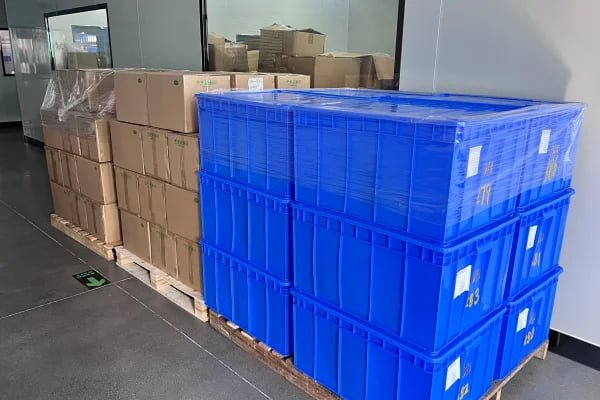
Pressure plus time fixes the shape
ISO 815-1 covers exactly this. The test measures how much a rubber part recovers after a period under constant compression. The standard states that the time and temperature of compression affect the result. So do the time, temperature and conditions of recovery.
That is what happened to this lot. After trimming, the parts were boxed and stacked, one box on another, waiting for shipment. Nobody opened the boxes. The parts stayed under load. Given enough time, the set became permanent. Nothing in the process looked wrong that week. The parts simply waited too long in the wrong position.
This is why "no stock production" is not a random rule. It drives the pressure-time product to zero.
| Storage method | Load on the part | Risk |
|---|---|---|
| Single layer, no stacking | Almost none | 낮음 |
| Three to five layers | Lower layers loaded | Medium over time |
| Full boxes stacked high, long term | Heavy load at the bottom | High |
| Vacuum or heavy compression packing | Load on every surface | Very high |
Stopping stock production is the main move. Neat stacking and a stack height limit are the supporting moves. All three together hold the line. One more rule: boxes are sealed only after the parts have cooled fully, so no part is packed warm.
Why Should Incomplete Filling and Deformation Be Traced Separately?
The report listed both defects on one line. One incomplete fill, sixty-three deformed.
Incomplete filling happens inside the cavity. Deformation happens after the part leaves it. Two causes, two fixes.

Mixed together, the fix lands on the wrong cause
Incomplete filling starts in the cavity. The amount of compound may be too low. Air may be trapped at a corner, so the compound cannot reach the edge. Mold temperature may be uneven, and one area sets before the rest of the compound arrives. The gate, the vents and the wall sections should all be settled before the mold is cut. We put those checks into a DFM checklist for silicone molds.
Deformation forms outside the cavity. Demolding, cooling, packing and storage each can start it. It has nothing to do with incomplete filling.
Trimming is a third subject. Every molded part carries some excess rubber at the parting line. That is the nature of the process. Removing it cleanly depends on the precision of the parting line and on stable curing parameters. When the parameters drift, the excess gets thicker and trimming gets harder.
ISO 9001 treats corrective action as a response to a cause, not to a symptom. If the causes are mixed, the action stays on the surface.
| Defect | Where it happens | Main cause | Fix direction |
|---|---|---|---|
| Incomplete fill | Inside the cavity | Shot weight, venting, mold temperature | Adjust process parameters |
| Deformation | After demolding | Stress, cooling, load | Change demolding and storage |
| Thick parting-line excess | At mold closing | Mold precision, cure parameters | Rework the mold, steady the parameters |
Separate the three, and responsibility becomes clear. Mix them, and the answer usually ends at "we will strengthen management".
Every custom silicone gasket manufacturer runs into this choice. Sorting the causes costs a day. Sorting them later costs a lot more.
Final Thoughts
We remade the whole batch. We told the customer early, and we pushed the remake through, so the wait stayed short.
Looking back, the problem did not sit in one place. The stress in the square ring came with the design. Packing the parts before they had set was a process gap. The pressure in storage was damage after the fact. Three together produced those sixty-three parts.
The final rules are plain. No stock production. No trimming. Neat stacking to prevent pressure. Full inspection before any stock ships. With all four in place, quality holds.
We build custom silicone gaskets in square, round and irregular shapes.
For a custom silicone gasket manufacturer, the hard part is not getting the first part right. It is getting the hundredth and the thousandth part right.
If you are holding a deformed batch, send us the drawing and the photos. Talk to us.
Frequently Asked Questions
Can a deformed gasket be pressed back into shape?
Mostly no. Rubber held under load long enough takes a permanent set, and pressing it back only works for a while. We scrapped all sixty-three pieces without sorting.
Why do custom silicone gasket manufacturers avoid holding stock?
Thin parts under load in a warehouse keep taking a set, and the longer they sit, the harder recovery becomes. Make-to-order tightens the lead time a little, but it removes the risk of stock deformation and the labor of full inspection.
Which is worse, incomplete filling or deformation?
An incomplete fill is a functional defect and breaks the seal. Deformation is an assembly defect, so the part will not fit or will not sit flat. Both fail, but the causes differ and they have to be traced separately.
About the Author & Dibo Tech
My name is Kunfa Ye, but friends call me Jeff. I was born in 1986, the year of the Tiger. In 2011, my brother Autumn Ye and I co-founded Dibo Tech, rooting ourselves in the silicone rubber industry for fifteen years. Building from scratch, we navigated industry cycles and learned the true rewards of hard work. We have always built our business on technical expertise and integrity.
The silicone industry touches every corner of modern manufacturing. I deeply believe that behind every product lies trust, and the essence of business is mutual gain. Over these years, my proudest achievement is not personal financial independence, but helping our clients optimize supply chains and boost production efficiency. Their success is far more rewarding than personal milestones. Today, I aim to give back by sharing insights, answering engineering questions, and connecting resources.
Brand Name: Dibo Tech Slogan: Dibo Technology Silicone Manufacturing Specialists Website: https://samxine.com/ Our Mission: Based on strong technical capabilities and quality first, we are committed to innovative and eco-friendly silicone rubber production, providing reliable silicone solutions while fulfilling social responsibilities for a sustainable future.
답글 남기기