

Medical-Grade Liquid Silicone Rubber: Liquid Injection Molding Process & Machines
Liquid silicone rubber for medical devices is not a material choice — it is a closed process. The compound stays sealed from drum to cavity, the cure is triggered by heat rather than peroxide, and every parameter that affects biocompatibility is either documented or it is not.
That closed loop is why medical programs run liquid injection molding (LIM) rather than compression. It is also why the questions that matter to a device buyer are different from the ones that matter to an industrial buyer: not "what hardness can you mold", but "which ISO 10993 endpoints did you test, on which lot, and what happens to the extractables profile after sterilization".
This guide covers the liquid silicone rubber process, the tooling, the documentation set, and the DFM decisions that determine whether a medical LSR program runs cleanly at 5,000 parts or at 5 million.
What Medical-Grade Liquid Silicone Rubber Actually Means
Liquid silicone rubber is a two-part platinum-cured elastomer, supplied as matched A and B components:
- Part A — vinyl-functional polydimethylsiloxane base with platinum catalyst
- Part B — hydride cross-linker, inhibitor and optional additives
They are pumped, mixed at a fixed ratio (1:1 by weight is common), and injected into a heated cavity where platinum-catalyzed hydrosilation crosslinks the polymer. Because the reaction adds across double bonds rather than decomposing a peroxide, it produces little or no cure by-product. That is the technical reason platinum LSR is preferred for body-contact parts, and it is also why post-cure still matters: volatiles and low-molecular fractions have to be driven out, not assumed away.
"Medical grade" is not a checkbox on a data sheet. It is a claim that depends on five variables:
- Contact type — skin, mucosa, blood path, tissue, bone
- Contact duration — limited, prolonged, or long-term under the device risk assessment
- Extractables and leachables targets for the intended use
- Sterilization method and validated cycles
- The quality system and market regulations the device falls under
Two suppliers can both ship "medical-grade liquid silicone rubber" and still deliver completely different documentation packages. The difference shows up in an audit, not in a quote.
Why Medical Programs Use LIM Instead of Compression
Compression molding works with solid HTV preforms and cannot meter liquid silicone rubber. Liquid silicone rubber is designed for metering and injection, and running it any other way means losing the properties that made it the right material in the first place.
| Liquid injection molding (LIM) | Compression molding | |
|---|---|---|
| 재료 | Two-part LSR, 1:1 | Solid HTV / HCR preform |
| Feed system | Closed drum → metering → cold runner | Open preform handled by operator |
| Cure | Platinum addition, seconds | Peroxide or addition, minutes |
| Contamination risk | Low — closed system | Higher — manual handling |
| Thin walls | 0.4–0.6 mm routinely | Limited by preform flow |
| Automation | High, robot demold common | Operator-dependent |
| Best for | Medical, high volume, tight tolerance | Thick parts, low volume, prototypes |
If a supplier offers "LSR compression molding", the useful follow-up question is whether they mean liquid silicone at all. In most cases they are describing solid silicone, and the documentation trail will not match what the device file requires.
The LIM Process, Stage by Stage
| Stage | What happens | Typical range |
|---|---|---|
| 1. Drum feed | A and B drawn from pails through metering pumps | Closed transfer, no manual handling |
| 2. Metering and mixing | Fixed ratio, static mixer homogenizes | 1:1 common; deviation held to ≤0.5–1% |
| 3. Cold runner | Mixed LSR held below cure onset | Roughly 5–25°C, grade and machine dependent |
| 4. Injection | Low-viscosity fill through valve, sprue or sub-gate | Thin walls and micro-features feasible |
| 5. Cure | Mold heat triggers platinum addition | Cavity 160–210°C; thin walls 10–90 s |
| 6. Demold | Robot, air blow or stripper | Polished cavities self-release |
| 7. Post-cure | Optional oven cycle for volatiles | 180–200°C for 2–4 h when specified |
Every one of those stages has a documented setpoint in a validated program. A supplier who can produce the table for your part is running a controlled process. A supplier who can only produce the finished part is running a process you cannot audit.
Cure Time and Cycle: What the Numbers Mean
For medical liquid silicone rubber, cure scales with wall thickness. Industry shortcuts use roughly 3–5 seconds per millimetre at 180°C, but the real figure depends on grade, part mass, gate balance, mold temperature uniformity and the validated dose for that specific tool.
Total LIM cycle for medical components typically lands between 20 and 120 seconds: simple thin parts at the low end, thick or complex geometries at the high end.
Two practical consequences follow.
First, cycle time is not a lever you pull to cut price. Shortening it below the validated window leaves unreacted low-molecular material in the part, which shows up later as extractables, low rebound or surface tack. That failure mode is covered in our guide to why silicone products become sticky.
Second, post-cure is a specification, not an optional step. Where a TDS or the device validation calls for 180–200°C for 2–4 hours, that cycle is part of the material's performance — skip it and the biocompatibility file no longer describes the part you shipped.
Machine and Tooling Requirements
A medical liquid silicone rubber cell is not a thermoplastic press with different barrels.
Machine side. Twin metering pumps with ratio control and alarms; a static or dynamic mixer immediately before injection; a cooled barrel, screw or plunger to prevent premature cure; zoned mold heating; injection speed and pressure profiling; shot-size monitoring. Clamp tonnage is calculated from projected cavity area times cavity pressure — flash control on LSR comes from tool shutoff and cavity pressure, not from brute clamping force.
Tooling side. A cold-runner manifold with valve gates for multi-cavity runs; heated cavity plates in hardened or stainless steel; vents at the last-fill areas; a gate strategy chosen around the cosmetic face and the sealing surface; and a cavity count that starts at one for validation and scales to 8, 16, 32 or 64 as volume and QA capacity allow.
The polish on those cavities is a functional decision for medical parts, not a cosmetic one — cleanability and inspectability both depend on it. The grade trade-offs are covered in our guide to silicone mold surface finish.
Biocompatibility: The Documents That Matter
Medical LSR is documented, not assumed. For a device program, request the following and read the scope, not just the certificate title:
| Document | What it covers | What to check |
|---|---|---|
| ISO 13485 certificate | Manufacturer's quality system | Scope and expiry, not just the logo |
| ISO 10993 series reports | Biological evaluation by contact type | Endpoints actually tested for your category |
| USP 클래스 VI | Biological reactivity tests | Whether it is required by your market at all |
| FDA 21 CFR 177.2600 | Food-contact rubber articles | Relevant only for crossover parts |
| Material TDS / SDS | Grade, cure profile, properties | Matches the lot on the COA |
| Lot traceability, COA / COC | Batch identity | Ties the part to the test report |
| Sterilization validation | Autoclave, EtO, gamma, e-beam | Validated on the finished device, not the resin |
| Extractables / leachables | Fluid-path and long-duration devices | Study conditions vs. intended use |
Two traps are worth naming. USP Class VI is not a substitute for ISO 10993 — it covers a defined set of reactivity tests, and a device file will still ask for the endpoints that match its contact category. And ISO 10993-1 is a framework, not a pass/fail test: it maps contact type and duration to a testing plan, which is why two devices made from the same compound can require different data. For crossover food-contact parts, FDA 21 CFR 177.2600 is the relevant reference — and only there.
Do not accept "medical grade" without a compound name, batch records and the specific endpoints your risk assessment calls for.
Where Liquid Silicone Rubber Parts Are Used
Respiratory and anesthesia — ventilator diaphragms, valves, mask cushions, elbow seals, breathing-circuit gaskets, CPAP interfaces.

Fluid handling and drug delivery — IV set membranes, pump diaphragms, peristaltic tubing segments, insulin pen septa, check valves, catheter tips, luers.

Wearables and skin contact — CGM and monitor skins, strap interfaces, pulse-ox pads, electrode gaskets, low-durometer comfort seals selected by wear time.

Surgical and short-term implant-adjacent — instrument grips, endoscopic seals, suction bulb valves, drainage components.
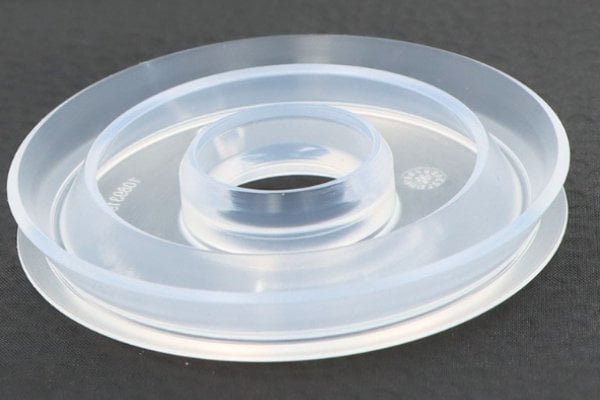
Long-term implant use is a separate category. It requires project-specific biological evaluation, extractables work, sterilization validation and regulatory review — it cannot be inferred from data generated on a non-implant part.
DFM Checklist for Medical LSR
- Uniform wall thickness; 0.4–0.6 mm is routine, thinner needs grade and tool validation
- Draft on every feature that seals or shows
- Gate placed away from sealing edges, catheter lumens and cosmetic surfaces
- Vents at last-fill areas; model air traps in long thin ribs
- No sudden thick-to-thin transitions — they cause shrink voids and cure imbalance
- Post-cure specified by compound and extractables target, not by habit
- Sterilization method fixed before tooling, because it changes material and packaging validation
- Inspection defined up front: FAI, CMM or optical report, hardness, visual AQL, biocompatibility file reference
Most medical LSR cost overruns trace back to items 6 and 7 being decided late. The tooling side of that equation is covered in our guide to silicone mold cost.
How to Audit a Medical LSR Supplier
Seven questions, each with a good answer and a warning sign.
1. Which compound, from which manufacturer, and what is the master file reference? A specific grade with a supplier is an answer. "Medical grade silicone" is not.
2. Show me the ISO 13485 scope. It should cover the molding activity and the site you are buying from.
3. Which ISO 10993 endpoints did you run, on which lot? The answer should match your contact category, not a generic list.
4. What is your post-cure profile, and is it documented per part? Temperatures, ramp, dwell and whether vacuum is used.
5. How do you control contamination between medical and non-medical work? Separate cells, gowning, material flow — or a sentence about being "careful".
6. What happens when a lot fails? Containment should include a 100% stock audit, not a replacement shipment. Our mixed parts case study shows what that looks like in practice.
7. Which cleanroom class, and how is it monitored? ISO Class 7 or 8 is common for medical LSR; the monitoring records matter more than the certificate.
Frequently Asked Questions
Is liquid injection molding the same as LSR injection molding?
Effectively yes. LIM uses liquid silicone rubber, and "liquid silicone injection molding" describes the same process family: A/B metering, mixer, cold runner, heated cavity. The terminology differs by region more than by technology.
Can liquid silicone rubber be compression molded?
Not in production. LSR is designed for metering and injection. Compression is used for solid HTV/HCR preforms. Prototypes are sometimes poured into open tools, but a medical production program runs LIM — otherwise the closed-system documentation trail does not exist.
How tight can LSR tolerances be?
Production LIM commonly holds around ±0.05 mm on small features, with tighter bands possible on selected dimensions through tool and process validation. Anything tighter should be justified by function, because it drives tooling cost and inspection time.
Which standards prove "medical grade"?
No single one. ISO 13485 covers the manufacturer's quality system; ISO 10993 covers biological evaluation; USP Class VI is a defined reactivity test set; FDA 21 CFR 177.2600 applies to food-contact articles. The finished device also needs sterilization and extractables data.
What is the minimum order for medical LSR parts?
It is set by tooling and validation, not by material. A validated medical program carries FAI, biocompatibility documentation and often a dedicated cleanroom slot, so small volumes are dominated by setup cost rather than piece price.
결론
Medical liquid silicone rubber is a system: the compound, the closed feed path, the cold runner, the cure window, the post-cure and the documentation that proves all of it. A part that passes dimensional inspection but has no ISO 10993 file behind it is not a medical part — it is silicone with a promising appearance.
If you are specifying a medical LSR program, send the drawing, the contact category and the sterilization method and we will return a DFM review with the documentation list your device file will need.
About the Author & Dibo Tech
My name is Kunfa Ye, but friends call me Jeff. I was born in 1986, the year of the Tiger. In 2011, my brother Autumn Ye and I co-founded Dibo Tech, rooting ourselves in the silicone rubber industry for fifteen years. Building from scratch, we navigated industry cycles and learned the true rewards of hard work. We have always built our business on technical expertise and integrity.
The silicone industry touches every corner of modern manufacturing. I deeply believe that behind every product lies trust, and the essence of business is mutual gain. Over these years, my proudest achievement is not personal financial independence, but helping our clients optimize supply chains and boost production efficiency. Their success is far more rewarding than personal milestones. Today, I aim to give back by sharing insights, answering engineering questions, and connecting resources.
Brand Name: Dibo Tech Slogan: Dibo Technology Silicone Manufacturing Specialists Website: https://samxine.com/ Our Mission: Based on strong technical capabilities and quality first, we are committed to innovative and eco-friendly silicone rubber production, providing reliable silicone solutions while fulfilling social responsibilities for a sustainable future.
답글 남기기